Carote Detachable Handle Cookware Set: 5-in-1 System Analysis


Executive Summary
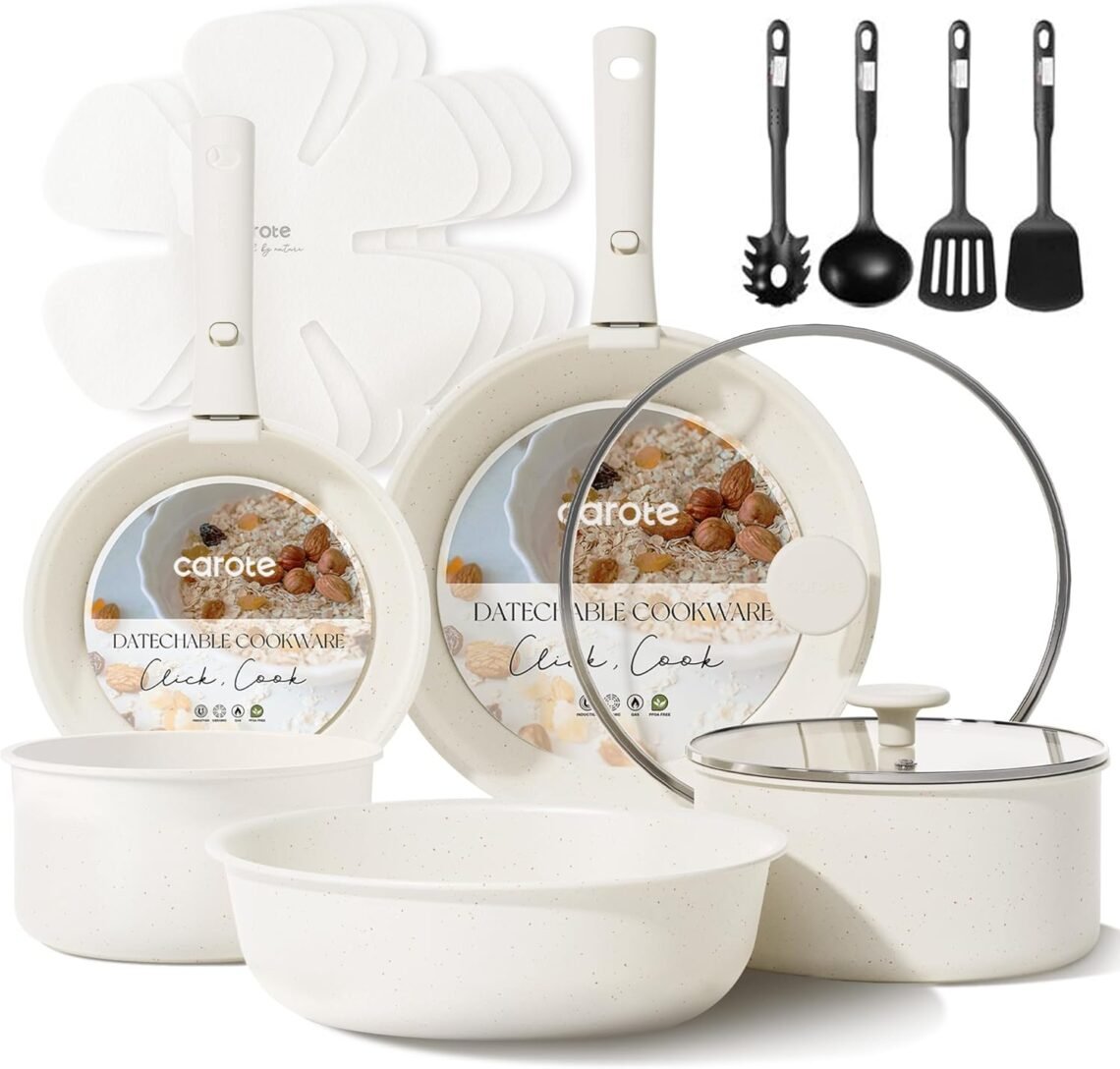
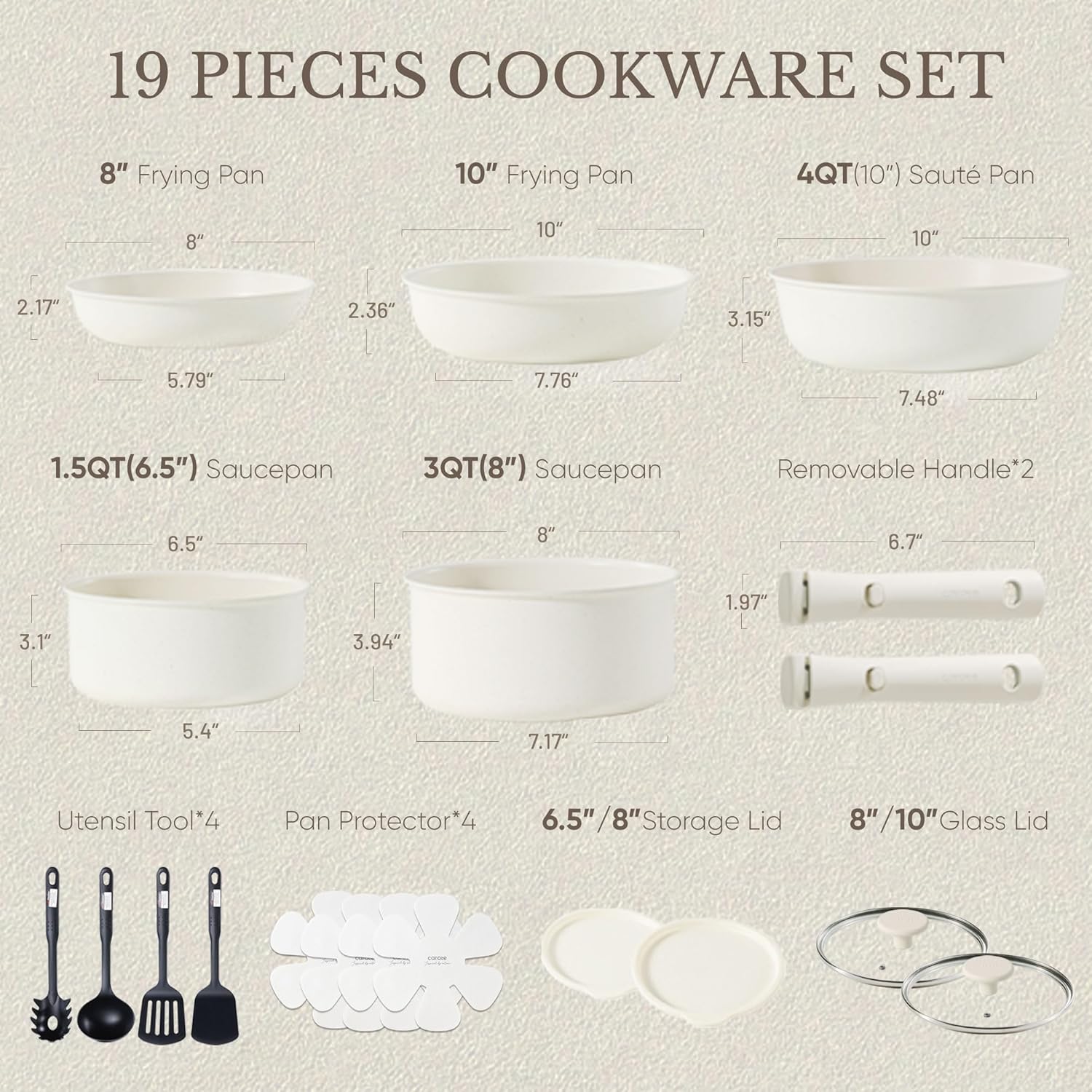
This Carote cookware system employs detachable handle technology enabling pots and pans to function across multiple cooking and storage applications. The set comprises five cooking vessels (two saucepans, two frying pans, one sauté pan), two removable handles, four cooking utensils, and four pot protectors. The removable handle design facilitates compact nested storage, oven use without handle interference, refrigerator storage in cooking vessels, and table serving directly from cookware. This analysis examines the detachable handle mechanism, non-stick coating technology, space-saving capabilities, and multi-functional applications of this modular cookware collection.
Contents
Complete Set Composition & Component Inventory
The set designation varies between “5-in-1” (referring to the five cooking vessels) and the total piece count including accessories. Understanding complete inventory clarifies what components the set provides.
Primary Cooking Vessels
Five pots and pans form the core cookware collection:
- 2-Quart Saucepan: Approximately 1.9-litre capacity for sauces, small portion cooking, heating liquids
- 3-Quart Saucepan: Approximately 2.8-litre capacity for medium batch cooking, pasta, vegetables
- 8-Inch Frying Pan: Approximately 20cm diameter for individual servings, eggs, small sautés
- 10-Inch Frying Pan: Approximately 25cm diameter for family portions, larger sautés, pan-frying
- 4-Quart Sauté Pan: Approximately 3.8-litre capacity with higher sides for braising, one-pot meals, larger volumes
Handle System Components
- 2 Detachable Handles: Removable clip-on handles fitting all cookware pieces through universal attachment mechanism
Accessory Components
- 4-Piece Utensils Set: Cooking tools (specific utensil types not detailed in provided documentation)
- 4 Pot Protectors: Fabric or felt pads preventing surface scratching when cookware stacks or nests
Total Piece Count
Complete set inventory:
- 5 cooking vessels (pots and pans)
- 2 detachable handles
- 4 utensils
- 4 pot protectors
Total: 15 pieces (though marketing may emphasise “5-in-1” referring specifically to the five primary cookware items)
Complete Set Inventory
| Component Type | Size/Capacity | Quantity | Primary Function |
|---|---|---|---|
| Saucepan | 2-qt / 1.9L | 1 | Sauces, small portions, heating liquids |
| Saucepan | 3-qt / 2.8L | 1 | Medium cooking, pasta, vegetables |
| Frying Pan | 8″ / 20cm diameter | 1 | Individual servings, eggs, small sautés |
| Frying Pan | 10″ / 25cm diameter | 1 | Family portions, larger sautés, frying |
| Sauté Pan | 4-qt / 3.8L | 1 | Braising, one-pot meals, high-volume cooking |
| Detachable Handle | Universal fit | 2 | Secure grip for all cookware pieces |
| Cooking Utensils | Standard size | 4 | Food preparation and cooking tasks |
| Pot Protectors | Fitted to cookware | 4 | Surface protection during stacking |
| Total Components | 15 pieces | ||
Capacity Measurement Context
Quart measurements follow US liquid quart standard:
- 1 US quart = 0.946 litres (approximately 950ml)
- 2 quarts ≈ 1.9 litres
- 3 quarts ≈ 2.8 litres
- 4 quarts ≈ 3.8 litres
UK users may find litre measurements more intuitive for recipe following and capacity assessment.
Detachable Handle Mechanism Design & Operation
The detachable handle system represents the defining feature distinguishing this cookware from traditional fixed-handle designs. Understanding mechanism operation clarifies usage requirements and safety considerations.
Attachment Mechanism Design
Detachable handle cookware typically employs one of several attachment systems:
Clip-On Mechanism (Most Common): Handle features spring-loaded clips or buttons that engage with brackets or rails attached to cookware rims. Pressing button releases clips, whilst releasing button locks clips into engaged position.
Bayonet Mount: Handle inserts into cookware attachment point then rotates to lock, similar to camera lens mounting systems. Less common for cookware applications.
Sliding Lock: Handle slides onto rim-mounted rail then locks via separate lever or switch mechanism.
Product imagery suggests clip-on mechanism as the most probable attachment method, though exact engineering details require manufacturer specification.
Universal Fit System
The two included handles fit all five cookware pieces through standardised attachment points:
Rim-Mounted Brackets: Each pot and pan features attachment brackets or mounting rails positioned on opposite sides of the rim, creating balanced lifting points when handle attaches.
Handle Compatibility: Handles designed to accommodate varying cookware diameters and rim thicknesses through adjustable clip width or universal bracket design.
Attachment Security: The manufacturer emphasises the handle is “upgraded for secure when attached during cooking,” suggesting design improvements addressing attachment strength and reliability concerns common in early detachable handle systems.
Operation Sequence
Proper handle attachment follows specific steps:
- Position Alignment: Orient handle perpendicular to cookware, aligning handle clips with rim brackets on both sides
- Clip Engagement: Press handle button (if button-release design) whilst positioning clips over brackets, then release button allowing clips to lock
- Security Verification: Gently lift cookware slightly off surface to confirm secure attachment before transferring weight or moving cookware
- Controlled Use: Maintain firm grip during cooking, avoiding sudden movements or impacts that might stress attachment points
- Safe Removal: After use, press release button whilst supporting cookware with other hand, lift handle away once clips disengage
Safety Locking Features
Quality detachable handle systems incorporate safety features preventing accidental release:
Positive Locking: Clips snap definitively into locked position with audible or tactile feedback confirming engagement.
Dual-Clip Design: Handles employ clips on both sides of rim rather than single-point attachment, distributing weight and providing redundancy if one clip partially fails.
Release Button Protection: Button positioning or guard features prevent accidental pressing during normal cooking grip positions.
Visual Indicators: Some designs include colour-coded indicators or alignment marks showing correct attachment.
Critical Safety Requirements
Attachment Verification: Always verify secure handle attachment before lifting cookware, particularly when containing hot liquids or foods. Test security with gentle upward pressure before committing full weight.
Weight Limits: Detachable handles may have maximum safe load limits. Avoid overfilling cookware beyond capacity, particularly with dense foods or liquids that create significant weight.
Handle Condition: Inspect handle clips and cookware brackets regularly for wear, damage, or deformation that might compromise attachment security. Replace damaged components immediately.
Heat Awareness: Cookware rims and attachment brackets become hot during cooking. Use oven mitt or towel when attaching handles to hot cookware fresh from hob or oven.
Space-Saving Storage System & Efficiency
The manufacturer claims detachable handles enable “up to 70% more space” savings compared to traditional cookware. Understanding space efficiency mechanisms clarifies storage advantages.
Space-Saving Mechanisms
Handle Removal Advantage: Fixed handles extend significantly beyond cookware diameter, creating wasted space when storing in cabinets or on shelves. Removing handles eliminates this projection, allowing cookware to nest more efficiently.
Nested Stacking: Cookware pieces of graduated sizes stack inside one another (smallest pan inside medium pan inside largest pan), consuming vertical space approximately equal to the largest piece rather than cumulative height of all pieces stored separately.
Compact Footprint: Nested cookware creates single footprint on shelf or in cabinet matching diameter of largest piece, rather than requiring separate space for each item.
Pot Protector Function: Included pot protectors cushion contact points between nested pieces, preventing scratching whilst enabling tight stacking without air gaps.
70% Space Savings Calculation
The claimed 70% reduction likely compares:
Traditional Storage (Baseline): Five pieces with fixed handles stored separately or loosely stacked occupy cumulative floor space equal to approximately 3-4 large pan diameters (accounting for handle extensions), plus vertical space equal to heights of all pieces stacked.
Nested Storage (Space-Saving): Five pieces nested occupy floor space equal to one large pan diameter, plus vertical space approximately 1.5-2 times the height of a single piece (accounting for rim stacking).
Exact percentage savings depend on specific cookware dimensions, handle lengths, and storage configuration, but substantial space reduction compared to traditional fixed-handle sets represents a verifiable advantage.
Storage Configuration Options
Vertical Nesting: Stack all pieces vertically with pot protectors between each layer. Store handles separately in drawer or alongside nested stack.
Horizontal Stacking: For shallow cabinet spaces, nest smaller pieces then position alongside larger pieces horizontally rather than stacking vertically.
Drawer Storage: Nested cookware fits in deep drawers more efficiently than traditional sets, with handles stored separately in utensil drawer.
Open Shelving: Compact nested configuration creates tidy appearance suitable for visible storage on open shelves or pot racks.
Comparative Storage Analysis
Storage Efficiency Comparison
| Storage Method | Approximate Floor Space | Approximate Height | Accessibility |
|---|---|---|---|
| Traditional Set (Separate Storage) | 3-4× large pan diameter | 5× individual heights stacked | High – direct access to each piece |
| Traditional Set (Loosely Stacked) | 2× large pan diameter | 3-4× individual heights | Moderate – unstacking required |
| Detachable Handle (Nested) | 1× large pan diameter | 1.5-2× individual height | Lower – complete unnesting for inner pieces |
| Detachable Handle (Partially Nested) | 1.5× large pan diameter | 2× individual height | Moderate – selective nesting by frequency |
Individual Cookware Pieces & Specifications
Each vessel serves specific cooking functions based on size, depth, and geometry. Understanding individual piece applications clarifies cookware selection for particular tasks.
2-Quart Saucepan (1.9L)
Dimensions: Approximately 16-18cm diameter, 8-10cm depth
Primary Applications:
- Heating sauces, gravies, and liquid-based preparations
- Cooking small portions (1-2 servings)
- Melting butter or chocolate
- Warming milk or cream
- Preparing small quantities of grains or pasta
Capacity Context: Suitable for individual or couple households, side dish preparation, or sauce making for 4-6 servings.
3-Quart Saucepan (2.8L)
Dimensions: Approximately 18-20cm diameter, 10-12cm depth
Primary Applications:
- Boiling pasta for 2-4 servings
- Cooking vegetables in water
- Preparing soups and stews for small families
- Making larger sauce batches
- Cooking grains (rice, quinoa) for multiple servings
Capacity Context: Family-sized portions for most applications, suitable for daily cooking in 2-4 person households.
8-Inch Frying Pan (20cm)
Dimensions: 20cm diameter cooking surface, 4-5cm depth
Primary Applications:
- Cooking 1-2 eggs
- Individual portion sautés
- Heating small quantities of food
- Making single-serving omelettes or frittatas
- Searing individual protein portions
Capacity Context: Individual serving size, ideal for solo cooking or preparing separate portions with different requirements (dietary restrictions, doneness preferences).
10-Inch Frying Pan (25cm)
Dimensions: 25cm diameter cooking surface, 5-6cm depth
Primary Applications:
- Cooking 3-4 eggs simultaneously
- Family-sized sautés and stir-fries
- Pan-frying proteins (chicken breasts, fish fillets, steaks)
- Making larger omelettes or frittatas
- General-purpose frying and browning
Capacity Context: Standard family cooking size, most versatile frying pan in set for daily use.
4-Quart Sauté Pan (3.8L)
Dimensions: Approximately 24-26cm diameter, 7-9cm depth
Primary Applications:
- One-pot meals combining multiple ingredients
- Braising meats with liquids
- Large-batch sautés requiring liquid additions
- Cooking pasta in sauce (finishing pasta in sauce rather than separately)
- Preparing casseroles or dishes requiring oven finishing
Capacity Context: Largest capacity in set, suitable for batch cooking, meal prep, or feeding larger families (4-6+ servings).
Cookware Selection by Cooking Task
| Cooking Task | Recommended Cookware | Alternative Option |
|---|---|---|
| Boiling Pasta (2 servings) | 3-qt Saucepan | 4-qt Sauté Pan (larger portions) |
| Frying 2 Eggs | 8″ Frying Pan | 10″ Frying Pan |
| Making Sauce | 2-qt or 3-qt Saucepan | Based on quantity required |
| Sautéing Vegetables (family portion) | 10″ Frying Pan or 4-qt Sauté Pan | Depends on quantity |
| One-Pot Meal | 4-qt Sauté Pan | 3-qt Saucepan (smaller portions) |
| Heating Soup (single serving) | 2-qt Saucepan | 3-qt Saucepan |
| Braising Chicken | 4-qt Sauté Pan | Requires higher sides for liquid |
| Steaming Vegetables | 3-qt Saucepan (with lid) | 4-qt Sauté Pan |
| Pan-Frying Fish | 10″ Frying Pan | 8″ Pan (small fillets only) |
| Making Omelette | 8″ Pan (individual) or 10″ Pan (larger) | Based on serving size |
Non-Stick Coating Technology & Performance
The manufacturer emphasises non-stick properties enabling “cleanup with ZERO elbow grease.” Understanding coating technology clarifies performance expectations and maintenance requirements.
Non-Stick Coating Composition
Product documentation does not specify exact coating chemistry. Common non-stick cookware coatings include:
PTFE-Based Coatings (Teflon-type): Polytetrafluoroethylene creates extremely low-friction surfaces preventing food adhesion. Modern PTFE coatings exclude PFOA (perfluorooctanoic acid) previously used in manufacturing processes but now phased out due to health concerns.
Ceramic Coatings: Sol-gel derived ceramic coatings provide non-stick properties through different chemistry than PTFE. Often marketed as “natural” or “eco-friendly” alternatives, though performance and durability characteristics differ from PTFE.
Granite or Stone-Derived Coatings: Marketing terms for mineral-reinforced non-stick coatings, typically PTFE or ceramic base with mineral particles for enhanced scratch resistance and appearance.
Without manufacturer specification, exact coating type remains unverified. The term “non-stick” without additional qualifiers suggests likely PTFE-based formulation as the industry standard.
Non-Stick Performance Characteristics
Food Release: Properly maintained non-stick surfaces allow eggs, fish, delicate foods, and sticky substances to release without adhesion, enabling cooking with minimal or no added fats.
Easy Cleaning: Food residues wipe away easily from non-stick surfaces compared to bare metal or poor-quality coatings requiring scrubbing. The manufacturer’s “ZERO elbow grease” claim emphasises this advantage.
Reduced Oil Requirements: Non-stick properties enable low-fat or fat-free cooking for health-conscious preparations, though small amounts of oil still improve flavour and browning.
Even Heating: The manufacturer claims “rapid & even heat transfer” though this property relates more to base material construction than coating itself. Non-stick coatings add minimal thermal resistance.
Coating Durability Factors
Non-stick coating lifespan depends on multiple variables:
Utensil Selection: Metal utensils scratch non-stick surfaces accelerating coating degradation. Silicone, wood, or plastic utensils preserve coating integrity. The included 4-piece utensil set likely features non-stick-safe materials.
Temperature Limits: PTFE coatings begin degrading above approximately 260°C (500°F). Ceramic coatings tolerate higher temperatures but may lose non-stick properties over time. Proper heat control prevents premature coating failure.
Cleaning Methods: Harsh scrubbing pads, abrasive cleaners, or dishwasher exposure (despite some products claiming dishwasher safety) accelerate coating wear. Gentle hand washing extends lifespan.
Storage Practices: The included pot protectors prevent scratching during stacked storage. Without protection, stacked cookware surfaces contact each other creating scratches over time.
Performance Longevity Expectations
Non-stick cookware coating lifespan varies by quality tier:
- Budget Non-Stick: 1-3 years typical lifespan with daily use and proper care
- Mid-Range Non-Stick: 3-5 years with proper maintenance and gentle use
- Premium Non-Stick: 5-7+ years for high-quality reinforced coatings with exemplary care
This Carote set likely falls within budget-to-mid-range category based on market positioning, suggesting 2-4 year expected coating performance with appropriate care practices.
Multi-Function Applications: Stove to Table
The detachable handle system enables cookware to transition between multiple functions beyond traditional stovetop cooking. Understanding multi-function capabilities clarifies the “5-in-1” designation and usage flexibility.
Stovetop Cooking Function
Primary Use: Traditional cooking with handles attached for control during heating, stirring, and food manipulation.
Heat Source Compatibility: Product claims compatibility with “ALL kinds of stoves” including gas, electric, ceramic, and induction (discussed in detail in heat compatibility section).
Handle Management: Attach handle to active cooking vessel, move between pieces as needed. Two handles enable simultaneous use of two cookware pieces if both require active handling.
Oven Use Function
Handle Removal Advantage: Detaching handles eliminates protruding handle interference in oven space, allowing cookware to sit flush on oven racks.
Space Efficiency: Multiple handle-free pieces fit in oven simultaneously where fixed handles would create spacing conflicts.
Oven-Safe Temperature: Product documentation does not specify maximum oven-safe temperature. Typical non-stick cookware tolerates 175-260°C depending on coating type and handle materials.
Safety Consideration: Always use oven mitts when retrieving cookware from oven. Without handles, pot holders or mitts must contact hot pan sides or rims directly.
Grill Use Function
Outdoor Cooking: Handle-free cookware places directly on outdoor grill grates for camping, barbecuing, or alternative cooking methods.
Stability: Flat-bottomed design without protruding handles creates stable positioning on uneven grill surfaces.
Heat Tolerance: Non-stick coating temperature limits apply equally to grill use. Avoid placing directly over intense flame creating excessive heat.
Refrigerator Storage Function
Leftover Storage: Cook, then remove handle and cover cookware (with appropriate lid if available or plastic wrap/aluminium foil) for direct refrigerator storage.
Space Efficiency: Handle-free storage occupies less refrigerator space than traditional cookware. Stackable configuration maximises vertical space utilisation.
Reheating Convenience: Remove from refrigerator, attach handle, reheat directly on stovetop or in oven without transferring contents to different vessel.
Food Safety Note: Transfer hot cookware contents to refrigerator only after cooling to room temperature to prevent raising internal refrigerator temperature.
Table Serving Function
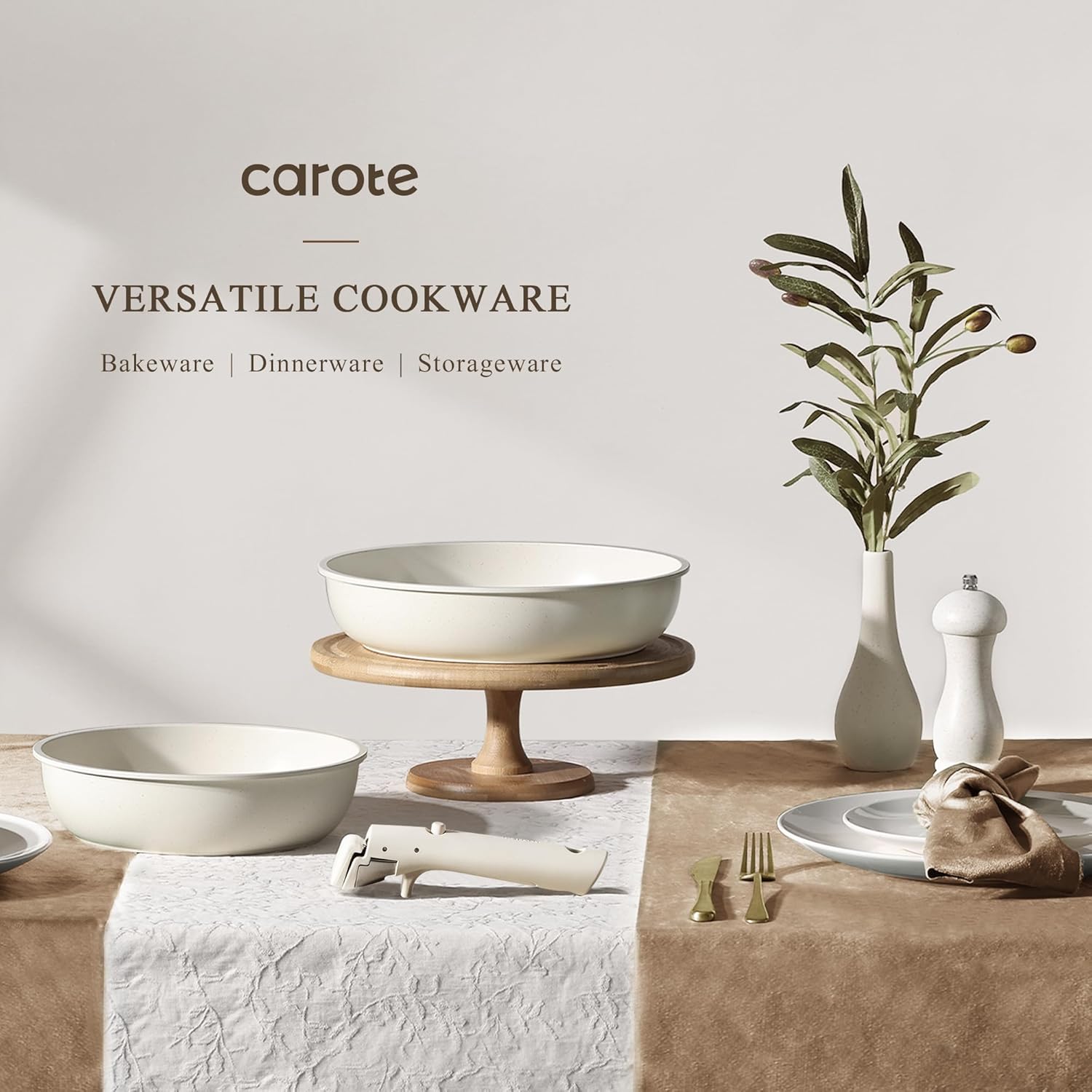
Direct Serving: Cook, remove handle, place cookware directly on table for family-style serving or individual plating.
Heat Protection Required: Use trivets, heat pads, or pot holders under hot cookware to protect table surfaces from heat damage.
Aesthetic Consideration: Handle-free cookware creates cleaner table presentation compared to traditional pots with protruding handles.
Dual Function: The manufacturer emphasises cookware functions “As both a cookware set and a dinnerware set, 1-time cleaning for all” – cook and serve in same vessel, eliminating serving dish washing.
Example Multi-Function Workflow
One-Pot Pasta Dinner Scenario
- Stovetop: Attach handle to 4-qt sauté pan, cook pasta with sauce on hob
- Oven (Optional): Remove handle, transfer to oven for cheese melting or casserole finishing
- Table Serving: Remove from oven with mitts, place directly on table trivet for family serving
- Refrigerator Storage: Cover leftovers in same pan, store in refrigerator without handle
- Reheating: Next day, remove from refrigerator, attach handle, reheat on stovetop
- Cleaning: Single pan washing instead of separate pot, serving dish, and storage container
Advantage: One cookware piece replaces cooking pot, serving dish, and storage container, reducing washing by 2/3 whilst saving storage space.
Heat Source Compatibility & Oven Use
The manufacturer claims compatibility with “ALL kinds of stoves.” Understanding specific heat source requirements and limitations clarifies appropriate usage.
Gas Hob Compatibility
Direct Flame Heating: Non-stick cookware works on gas hobs with proper flame control. Adjust flame size to match cookware base diameter, avoiding flames extending beyond base onto sides.
Temperature Control: Gas provides instant heat adjustment crucial for non-stick coating preservation. Reduce flame to prevent overheating above coating temperature limits.
Stability: Flat-bottomed design sits securely on gas hob grates. Smaller pans (8″ frying pan, 2-qt saucepan) require appropriately sized burners for stability.
Electric Coil/Solid Plate Compatibility
Direct Contact Heating: Cookware bases contact electric heating elements directly, requiring flat bottoms for efficient heat transfer.
Element Sizing: Match cookware diameter to heating element size when possible. Oversized elements waste energy and may overheat pan edges; undersized elements create hot spots.
Heat Retention: Electric elements retain heat after turning off. Remove cookware from hot elements promptly to prevent residual heat overheating.
Ceramic/Glass Hob Compatibility
Smooth Surface Contact: Flat cookware bottoms ensure complete contact with smooth ceramic glass surfaces for efficient heating.
Scratch Prevention: Avoid sliding cookware across ceramic surfaces. Lift and place rather than dragging to prevent scratching both cooktop and cookware base.
Temperature Response: Ceramic hobs heat and cool more slowly than gas. Anticipate temperature changes when adjusting heat settings.
Induction Hob Compatibility
Magnetic Base Requirement: Induction cooking requires ferromagnetic (magnetic) cookware bases. Test compatibility by verifying magnet adheres to cookware bottom.
Compatibility Verification: Product claims should specify “induction compatible” or “induction ready.” If documentation unclear, test with magnet before purchasing specifically for induction use.
Heating Characteristics: Induction creates rapid, precise heating ideal for non-stick cookware requiring careful temperature control. Cookware base heats whilst sides remain relatively cooler.
Base Construction: Induction-compatible cookware requires steel or magnetic stainless steel base layer. Aluminium cookware requires magnetic disc bonded to bottom for induction functionality.
Oven Use Specifications
Temperature Limits: Maximum oven-safe temperature not specified in provided documentation. Typical ranges:
- PTFE non-stick coatings: Safe to approximately 260°C (500°F)
- Silicone or heat-resistant handles (when attached): Often limit to 175-230°C
- Detached handles: Cookware bodies may tolerate higher temperatures depending on base material
Handle Removal Requirement: Always remove handles before oven use to prevent handle material degradation and ensure cookware fits properly on oven racks.
Retrieval Method: Use oven mitts or pot holders to grasp hot cookware rims when removing from oven. Handle-free design requires full-hand contact with hot surfaces.
Heat Source Compatibility Summary
| Heat Source | Compatibility | Special Considerations |
|---|---|---|
| Gas Hob | Compatible | Control flame size, avoid extending beyond base |
| Electric Coil | Compatible | Match element size, remove from hot elements promptly |
| Ceramic/Glass Hob | Compatible | Avoid sliding, ensure flat base contact |
| Induction Hob | Verify Compatibility | Requires magnetic base – test with magnet |
| Oven | Compatible (handles removed) | Observe temperature limits, use mitts for retrieval |
| Outdoor Grill | Limited Use | Avoid direct flame, monitor temperature carefully |
Material Construction & Durability
Understanding base material construction clarifies heat distribution properties, durability expectations, and compatibility characteristics.
Base Material Composition
Product documentation does not specify exact base material. Common non-stick cookware constructions include:
Aluminium Base: Lightweight, excellent heat conductivity, economical manufacturing. Most budget-to-mid-range non-stick cookware employs aluminium bases.
Stainless Steel with Aluminium Core: Durable stainless exterior with aluminium core for heat distribution. Heavier and more expensive than pure aluminium.
Hard-Anodised Aluminium: Electrochemically hardened aluminium surface creating wear-resistant finish. Darker appearance, enhanced durability compared to standard aluminium.
The lightweight emphasis and price positioning suggest standard aluminium construction as most probable base material, possibly with induction-compatible magnetic disc if induction compatibility claimed.
Heat Distribution Properties
The manufacturer claims “rapid & even heat transfer” suggesting design attention to heating performance:
Aluminium Conductivity: Aluminium conducts heat approximately 4 times better than stainless steel, enabling rapid temperature response and relatively even heat distribution.
Base Thickness: Thicker bases distribute heat more evenly but respond more slowly to temperature changes. Thin bases heat rapidly but may create hot spots. Standard non-stick cookware employs 2-3mm base thickness balancing responsiveness with distribution.
Encapsulated Bases: Higher-quality construction may feature encapsulated bases with steel exterior layers sandwiching aluminium core, optimising heat distribution whilst enabling induction compatibility.
Structural Durability
Warping Resistance: Rapid temperature changes or overheating can warp thin aluminium bases. Proper heat control and avoiding thermal shock (placing hot pan under cold water) prevents warping.
Rim Construction: Reinforced rims where detachable handles attach ensure structural integrity under repeated handle attachment/removal cycles and cooking weight.
Handle Bracket Durability: Rim-mounted attachment brackets must withstand repeated clip engagement/release without loosening, bending, or breaking. Quality construction employs robust bracket designs resisting wear.
Weight Considerations
Lightweight Advantage: Aluminium construction creates relatively light cookware compared to cast iron or heavy-gauge stainless steel. Lighter weight reduces handling fatigue and simplifies storage manipulation.
Stability Trade-Off: Very lightweight cookware may feel less substantial or stable than heavier alternatives. Adequate base thickness balances light weight with sufficient mass for stable cooking.
Included Accessories: Utensils & Pot Protectors
The set includes supplementary components enhancing functionality and protecting cookware investment.
4-Piece Utensils Set
Composition Unknown: Product documentation does not specify which four utensils the set includes. Common non-stick cookware utensil sets typically comprise:
- Slotted turner/spatula
- Solid turner/spatula
- Serving spoon or ladle
- Pasta server or slotted spoon
Material Considerations: Utensils included with non-stick sets typically employ silicone, nylon, or wood construction preventing coating scratching. Metal utensils damage non-stick surfaces and should not be included with quality sets.
Heat Resistance: Silicone utensils tolerate heat contact during cooking without melting or degrading. Nylon utensils have lower heat tolerance and may melt if left resting against hot cookware edges.
4 Pot Protectors
Function: Pot protectors are fabric, felt, or foam pads placed between nested cookware pieces preventing surface contact that causes scratching.
Material Construction: Common protector materials include:
- Felt Pads: Soft, cushioning, washable
- Fabric with Padding: Quilted or padded cloth providing cushioning
- Foam Inserts: Lightweight foam cut to fit cookware shapes
Usage: Place protector on bottom of each cookware piece before stacking next piece on top. Four protectors enable protection between five nested pieces (bottom piece requires no protector beneath it).
Maintenance: Fabric protectors may require periodic washing to remove dust or residues. Foam protectors wipe clean but may compress over time requiring replacement.
Lids Status
Lids Not Included: Product documentation does not mention lids as included components. The set appears to provide cookware bodies, handles, utensils, and protectors but not lids.
Aftermarket Lid Options: Users requiring lids must purchase separately, selecting universal lids matching cookware diameters or manufacturer-specific lids if available.
Alternative Covering: Temporary covering using aluminium foil, plates, or other flat items may suffice for occasional use, though dedicated lids provide better moisture retention and heat distribution.
Maintenance, Cleaning & Longevity
Proper care practices significantly extend non-stick coating lifespan and overall cookware durability.
Initial Use Preparation
First Wash: Before initial use, wash all cookware pieces with warm soapy water, rinse thoroughly, and dry completely.
Seasoning (Optional): Some manufacturers recommend light oil coating and heating before first use, though modern non-stick coatings typically don’t require seasoning like cast iron.
Handle Testing: Verify handle attachment mechanisms operate smoothly, clips engage securely, and release buttons function properly before cooking use.
Daily Cleaning Procedures
Cooling First: Allow cookware to cool to warm (not hot) temperature before washing. Thermal shock from plunging hot pans into cold water can warp bases or damage coatings.
Gentle Hand Washing: Despite potential dishwasher-safe claims, hand washing with soft sponge or cloth extends coating life:
- Rinse with warm water to remove loose food particles
- Apply mild dish soap to soft sponge or cloth
- Gently wash interior and exterior surfaces
- Rinse thoroughly removing all soap residue
- Dry completely with soft towel before storage
Avoid Abrasives: Never use steel wool, abrasive scrubbing pads, harsh cleansers, or abrasive cleaning powders on non-stick surfaces.
Stubborn Residue Removal
Soaking Method: For stuck food, fill cookware with warm soapy water, allow 15-30 minutes soaking, then wash normally.
Bicarbonate of Soda Paste: For persistent residues, create paste from bicarbonate of soda and water, apply to affected areas, allow brief contact, then wash gently.
Avoid Scraping: Never use metal utensils, knives, or scrapers to remove stuck food. Soaking and gentle washing preserve coating integrity.
Handle Mechanism Maintenance
Regular Cleaning: Clean handle attachment points and cookware brackets periodically, removing food particles or grease accumulation that might interfere with clip engagement.
Inspection Schedule: Monthly inspection of handle clips for wear, bending, or damage. Test secure attachment on each cookware piece.
Lubrication (If Applicable): Some mechanisms may benefit from occasional food-safe silicone lubricant on pivot points, though many designs require no lubrication.
Storage Best Practices
Pot Protector Use: Always use included protectors when nesting cookware to prevent scratching.
Complete Drying: Ensure all pieces completely dry before nesting to prevent moisture retention causing odours or potential corrosion of attachment hardware.
Handle Storage: Store detached handles in accessible location – dedicated drawer space or hung on hooks near cookware storage.
Avoid Overcrowding: Don’t force additional items into nested cookware stack that might stress pieces or compress pot protectors excessively.
Longevity Extension Strategies
Temperature Control: Use low-to-medium heat for most cooking. Non-stick surfaces require less heat than traditional cookware due to superior heat retention and distribution.
Cooking Sprays Caution: Some cooking sprays contain additives that create residue buildup on non-stick surfaces. Use butter, oil, or choose spray products specifically formulated for non-stick cookware.
Proper Utensils Only: Use only silicone, wood, nylon, or other non-stick-safe utensils. Metal utensils scratch coatings regardless of how careful users attempt to be.
Avoid Empty Heating: Never heat empty cookware. Always add oil, butter, or food before applying heat to prevent coating damage and base warping.
Recommended Maintenance Schedule
| Frequency | Maintenance Task | Purpose |
|---|---|---|
| After Each Use | Gentle hand washing, complete drying, pot protector placement | Basic cleanliness, coating preservation |
| Weekly | Inspect handle attachment security, clean attachment brackets | Safety verification, mechanism functionality |
| Monthly | Deep clean handle mechanisms, examine coating condition, check for warping | Early problem detection, preventive maintenance |
| Quarterly | Comprehensive inspection of all pieces, pot protector condition check | Long-term durability assessment |
| As Needed | Replace worn pot protectors, address coating damage, repair/replace damaged handles | Component replacement, safety maintenance |
Safety Considerations & Proper Usage
Detachable handle cookware introduces unique safety requirements beyond traditional fixed-handle designs.
Handle Attachment Safety
Pre-Use Verification: Before lifting cookware containing food or liquids:
- Visually confirm both clips engaged with brackets
- Gently test security by applying slight upward pressure before committing full weight
- Listen for audible “click” if mechanism provides acoustic feedback
- Ensure handle oriented properly for balanced weight distribution
Weight Limitations: Avoid overfilling cookware beyond capacity markings. Excessive weight stresses attachment mechanisms and increases spill risks if attachment fails.
Movement Caution: When moving cookware with handle attached:
- Support pan bottom with other hand when possible for redundant support
- Avoid sudden movements, swinging, or impacts that stress clips
- Keep cookware level to prevent liquid sloshing adding dynamic loads
- Move slowly and deliberately, particularly with hot contents
Heat-Related Safety
Handle Heat Transfer: Handles may become warm during extended cooking despite detached from cookware body. Some heat transfers through clips contacting hot rim brackets.
Rim Heat: Cookware rims and attachment brackets become extremely hot during cooking. Use oven mitt or towel when attaching handles to actively cooking pans.
Handle-Free Retrieval: When retrieving cookware from oven or handling without attached handle, use proper oven mitts or pot holders providing full-hand protection.
Cooling Before Storage: Allow cookware to cool completely before nesting or adding pot protectors. Hot cookware can melt or damage fabric protectors.
Coating Preservation for Safety
Damage Monitoring: Inspect non-stick coating regularly for:
- Scratches exposing base material
- Peeling or flaking coating
- Discolouration indicating overheating damage
- Surface roughness from wear
Damaged Coating Protocol: If coating shows significant damage (peeling, flaking, large scratched areas), discontinue food use. Damaged non-stick coatings may release particles into food.
PTFE Safety Context: Modern PTFE coatings are considered safe for normal cooking temperatures. Overheating above 260°C can release fumes irritating to humans and potentially harmful to birds. Proper temperature control prevents fume release.
Child Safety
Handle Accessibility: Store detached handles beyond children’s reach. Children should not operate detachable handle mechanisms without supervision.
Cookware Stability: Without fixed handles, handle-free cookware on stovetops may appear less obvious as “in use” to children. Maintain vigilant supervision when cookware sits on active heat sources.
Hot Surface Awareness: Teach children that handle-free cookware requires extra caution – lack of protruding handle doesn’t indicate cookware is cool or safe to touch.
Emergency Procedures
Handle Failure Response: If handle unexpectedly releases during use:
- Do not attempt to catch falling cookware – let it fall and step back to avoid hot content splashes
- Turn off heat source immediately
- Allow spilled contents and cookware to cool before cleanup
- Inspect handle mechanism before further use
- Do not reuse if handle shows damage or attachment failure cause unclear
Burn Treatment: For burns from hot cookware contact:
- Immediately run cool (not ice cold) water over affected area for 10-15 minutes
- Do not apply ice, butter, or ointments immediately
- Seek medical attention for serious burns covering large areas or showing blistering
- Keep first aid supplies accessible in kitchen
Complete Technical Specifications
Complete Set Specifications
| Specification Category | Details |
|---|---|
| Total Pieces | 15 pieces (5 cookware + 2 handles + 4 utensils + 4 protectors) |
| Cookware Included | 2-qt saucepan, 3-qt saucepan, 8″ frying pan, 10″ frying pan, 4-qt sauté pan |
| Handle System | 2 detachable handles with universal fit mechanism |
| Base Material | Not specified (likely aluminium construction) |
| Coating Type | Non-stick coating (composition not specified) |
| Heat Compatibility | Gas, electric, ceramic, induction (verify), oven (handles removed) |
| Oven Safe Temperature | Not specified (typical 175-260°C range) |
| Dishwasher Safe | Not specified (hand washing recommended) |
| Accessories | 4 cooking utensils, 4 pot protectors |
| Space Savings Claim | Up to 70% more space vs traditional cookware |
| Warranty | 12 months from purchase date |
| Brand | Carote |
| Lids Included | No (not mentioned in specifications) |
Cookware Capacity Reference
| Cookware Piece | Capacity (US Quarts) | Capacity (Litres) | Approx. Diameter | Typical Servings |
|---|---|---|---|---|
| Small Saucepan | 2 qt | 1.9L | 16-18cm | 1-2 servings |
| Medium Saucepan | 3 qt | 2.8L | 18-20cm | 2-4 servings |
| Small Frying Pan | N/A | ~0.8L | 20cm (8″) | 1-2 servings |
| Large Frying Pan | N/A | ~1.5L | 25cm (10″) | 2-4 servings |
| Sauté Pan | 4 qt | 3.8L | 24-26cm | 4-6 servings |
Analysis Summary
The Carote detachable handle cookware set addresses kitchen storage and functionality challenges through modular design enabling handles to attach and remove as needed. The five-piece cookware collection spanning 1.9 to 3.8 litres provides graduated sizing for varied cooking applications from individual portions to family meals, whilst the universal handle system allows two handles to serve all five vessels.
The space-saving advantage represents the primary value proposition, with nested storage consuming claimed 70% less cabinet space than traditional fixed-handle equivalents. This efficiency particularly benefits small kitchens, student accommodations, caravans, or any space-constrained cooking environment. The ability to stack handle-free cookware also enables refrigerator storage of leftovers in cooking vessels and oven use without protruding handle interference.
Non-stick coating facilitates easy food release and simplified cleaning, though specific coating composition remains undisclosed. Expected coating lifespan falls within typical 2-4 year range for budget-to-mid-range non-stick cookware given proper care including gentle hand washing, non-metal utensil use, and appropriate heat control. The included pot protectors preserve coating integrity during nested storage.
The detachable handle mechanism introduces unique safety requirements including mandatory attachment verification before lifting, weight limit awareness, and proper technique when moving cookware. The upgraded handle design claims improved security, though users must develop consistent safety practices around attachment/detachment procedures. Handle mechanisms represent potential failure points requiring periodic inspection and maintenance.
Multi-function capability enables cookware to transition from stovetop to oven to refrigerator to table, eliminating separate serving dishes and storage containers for complete meals. This versatility supports one-pot cooking workflows reducing both dishwashing requirements and kitchen clutter. The absence of included lids represents a notable limitation requiring separate lid purchases for covered cooking applications.
The set suits households prioritising storage efficiency, multi-function versatility, and simplified cleaning over absolute cooking performance or extreme durability. Small kitchens, mobile living situations (RVs, boats), and users seeking streamlined cookware collections benefit most from the space-saving and multi-use characteristics. Users requiring maximum non-stick longevity, professional-grade construction, or traditional fixed-handle security may find limitations in budget-positioned detachable handle systems.
Proper usage requires developing new habits around handle attachment/verification, understanding temperature limits for oven use, and maintaining gentle care practices preserving non-stick coating longevity. The 12-month warranty provides limited protection compared to lifetime warranties on premium cookware, suggesting expected product lifespan of 3-5 years with appropriate maintenance before replacement consideration.
Ideal Usage Scenarios
| User Profile | Primary Benefits | Recommended Pieces for Priority Use |
|---|---|---|
| Small Apartment Dweller | 70% space savings, compact nested storage | All pieces – maximize storage efficiency |
| Student/First Kitchen | Complete set, affordable, easy cleaning | 10″ frying pan, 3-qt saucepan (most versatile) |
| Caravan/RV Owner | Portable, space-efficient, oven-to-fridge versatility | All pieces for varied mobile cooking needs |
| Meal Prep Enthusiast | Cook-store-reheat in same vessel, reduced washing | 4-qt sauté pan, 3-qt saucepan for batch cooking |
| Minimalist Cook | Multi-function reduces kitchen clutter | 10″ frying pan, 3-qt saucepan, 4-qt sauté pan |
| Couple Household | Appropriate capacity range, storage efficiency | 8″ and 10″ pans, 2-qt and 3-qt saucepans |
| Family of 4-6 | Large capacity sauté pan for one-pot meals | 4-qt sauté pan, 10″ frying pan, 3-qt saucepan |
| Limited Mobility User | Lightweight construction, easier handling | Smaller pieces (8″ pan, 2-qt saucepan) for safety |
Cookware System Comparison Context
Detachable vs Fixed Handle Systems
Understanding comparative advantages assists in cookware selection decisions:
Detachable Handle Advantages
- Storage Efficiency: 50-70% space reduction through nested stacking
- Oven Versatility: No protruding handles interfering with oven space or rack positioning
- Refrigerator Storage: Compact storage of leftovers in cooking vessels
- Table Serving: Cleaner presentation for direct-from-cookware serving
- Transport Friendly: Compact packing for mobile kitchens or camping
Fixed Handle Advantages
- Immediate Usability: Always ready to lift without attachment step
- No Mechanism Failure Risk: Permanent attachment eliminates clip failure concerns
- Traditional Familiarity: Conventional design requires no learning curve
- Stay-Cool Handle Options: Insulated fixed handles available for heat protection
- Perceived Durability: Simpler construction with fewer moving parts
Decision Factors
Choose Detachable Handle Systems When:
- Storage space is severely limited
- Multi-function capability (stove/oven/fridge/table) provides daily value
- Mobile or portable cooking applications dominate usage
- Simplified cleaning and reduced dishwashing are priorities
Choose Fixed Handle Systems When:
- Storage space is adequate
- Traditional cooking workflows are preferred
- Maximum attachment security is paramount
- Simplicity and familiarity outweigh space efficiency
Carote Brand Context
Carote markets itself with the tagline “Click, Cook, Carote” emphasising the click-mechanism handle attachment system central to their detachable handle product line.
Brand Positioning
- Innovation Focus: Detachable handle systems and space-saving solutions as core differentiation
- Value Proposition: Affordable pricing for innovative cookware designs
- Non-Stick Specialisation: Primary focus on non-stick coated cookware across product ranges
- Lifestyle Marketing: Emphasis on modern, space-efficient living solutions
Warranty and Support
The manufacturer provides 12-month warranty from purchase date with commitment to “satisfying solution” for quality problems. This warranty period is shorter than premium cookware brands offering lifetime guarantees but standard for budget-to-mid-range cookware categories.
Warranty Coverage Considerations:
- Verify whether warranty covers both cookware bodies and detachable handle mechanisms
- Understand exclusions (normal wear, coating degradation, misuse damage)
- Retain proof of purchase documentation for potential claims
- Contact manufacturer directly for quality concerns rather than solely relying on retailer mediation
Recommended Complementary Items
| Item Category | Purpose | Priority Level |
|---|---|---|
| Universal Lids (multiple sizes) | Enable covered cooking for all pieces | High – essential for many cooking applications |
| Additional Pot Protectors | Replace worn protectors, enable double-layer protection | Medium – extends coating lifespan |
| Silicone Oven Mitts | Safe handling of handle-free hot cookware | High – critical for oven use safety |
| Trivets or Heat Pads | Table surface protection for direct serving | Medium – enables table serving function |
| Non-Stick Safe Utensils (additional) | Supplement included 4-piece set | Low – if included set proves sufficient |
| Wooden Cutting Board | Gentle surface for food prep protecting counters | Medium – pairs well with non-stick cookware |
| Replacement Handle (spare) | Backup if mechanism fails or wears | Low – only if handles show wear or frequent use |
Common Usage Questions
Can I use metal utensils with this cookware?
Answer: No. Metal utensils scratch non-stick coatings accelerating wear and potentially releasing coating particles. Use only silicone, wood, nylon, or other non-stick-safe utensils. The included 4-piece utensil set should employ appropriate materials.
How many handles do I need for normal cooking?
Answer: The included two handles accommodate most cooking scenarios. Two handles enable simultaneous use of two pans (e.g., frying pan and saucepan), whilst additional pieces wait without handles. Users cooking with 3+ pieces simultaneously might prefer purchasing additional handles if available separately.
Can I put lids on cookware while handles are attached?
Answer: If lids are purchased separately, compatibility depends on lid design and handle positioning. Universal lids typically accommodate handles, though clearance should be verified. Some users remove handles after initial cooking phase, add lid for simmering, then reattach handle for serving.
What if the handle breaks or clips wear out?
Answer: Contact manufacturer regarding replacement handle availability. The 12-month warranty should cover manufacturing defects in handle mechanisms. Beyond warranty period, check if replacement handles sell separately. Damaged handles should not be used due to safety risks.
How do I know if my cooktop is induction-compatible?
Answer: Induction cooktops require magnetic cookware. Test by placing magnet against cookware base – if magnet adheres strongly, cookware is induction-compatible. If magnet doesn’t stick, cookware won’t work on induction hobs. Verify product specifications explicitly claim induction compatibility before purchasing for induction use.
Can I stack hot cookware fresh from the stove?
Answer: No. Allow cookware to cool completely before nesting. Hot cookware can damage pot protectors (melting fabric or deforming foam), and temperature differentials between nested pieces may cause warping or coating damage.
Is the non-stick coating safe if scratched?
Answer: Minor scratches don’t immediately render cookware unsafe, but they compromise non-stick performance and appearance. Monitor scratched areas for coating flaking or peeling. If coating begins separating from base, discontinue food use to prevent coating particles entering food. Modern PTFE coatings are generally considered non-toxic even if ingested, but prevention remains preferable.
Can I use cooking spray with this cookware?
Answer: Some cooking sprays contain additives creating sticky residue buildup on non-stick surfaces over time. If using spray, choose products specifically formulated for non-stick cookware, or use butter/oil applied with paper towel for better coating preservation.
Sustainability and Lifecycle Considerations
Resource Efficiency
Reduced Material Consumption: Multi-function design eliminating need for separate serving dishes and storage containers reduces overall kitchen equipment requirements.
Space Efficiency Impact: Smaller living spaces consume fewer resources for heating, cooling, and construction. Cookware enabling efficient small-kitchen living supports broader sustainability goals.
Energy Efficiency: Aluminium’s excellent heat conductivity enables lower cooking temperatures and faster heating compared to poor heat conductors, potentially reducing energy consumption over product lifetime.
Expected Product Lifespan
Budget-to-mid-range non-stick cookware typically provides 3-5 year functional lifespan:
- Coating Degradation: Non-stick properties diminish gradually, typically becoming significantly compromised at 2-4 year mark with daily use
- Handle Mechanism Wear: Detachable components experience wear from repeated attachment/removal cycles, potentially requiring replacement before coating failure
- Base Integrity: Aluminium bases may warp with heavy use or thermal abuse, though proper care extends structural integrity beyond coating lifespan
End-of-Life Considerations
Recycling Potential: Aluminium cookware bases are recyclable through scrap metal programmes. Remove non-metallic components (non-stick coating, handles, pot protectors) if possible for proper material stream separation.
Component Reuse: If cookware bodies fail but handles remain functional, handles might serve replacement cookware from same manufacturer. Conversely, worn handles might necessitate cookware replacement despite functional coating.
Responsible Disposal: Contact local council regarding proper cookware disposal. Some areas accept cookware in metal recycling; others require landfill disposal. Non-stick coatings complicate recycling but modern formulations pose minimal environmental hazard in landfills.
Repair vs Replace Economics
Budget cookware sets typically favour replacement over repair:
- Individual replacement handle costs may approach 30-50% of complete set price
- Coating cannot be economically restored once damaged
- Warped bases cannot be repaired
- Set replacement provides fresh coating on all pieces versus single-piece replacement
Premium cookware justifies repair investment; budget sets generally prove more economical to replace when primary components fail.
Essential Care Tips for Maximum Longevity
Daily Habits
- Use low-to-medium heat for all cooking (non-stick requires less heat than traditional cookware)
- Always verify handle attachment security before lifting
- Hand wash gently with soft sponge and mild soap
- Dry completely before nesting with pot protectors
- Use only silicone, wood, or nylon utensils (never metal)
Avoid These Damaging Practices
- High heat or empty pan heating (warps base, damages coating)
- Metal utensils (scratches coating irreversibly)
- Abrasive cleaning pads or harsh chemicals
- Thermal shock (plunging hot pan into cold water)
- Dishwasher cleaning (accelerates coating wear)
- Cooking sprays with additives (creates sticky buildup)
- Stacking without pot protectors (scratches surfaces)
Weekly Maintenance
- Inspect handle clips and brackets for wear or damage
- Test attachment security on all cookware pieces
- Clean pot protectors if showing residue accumulation
- Examine coating for scratches, wear, or damage progression
Product Availability
This Carote detachable handle cookware set is available through various retailers including Amazon UK. Product specifications, colour options, and included components may vary by seller and region.
As an Amazon Associate I earn from qualifying purchases.
Product specifications and availability subject to change. Verify current details, warranty terms, and included components with retailer before purchase. Detachable handle cookware requires specific usage and safety practices – review all manufacturer guidelines before use.


5 Comments on “detachable handle cookware set”
Comments are closed.