34-Piece Kitchen Utensils Set: Silicone Tools with Wooden Handles Analysis


Executive Summary
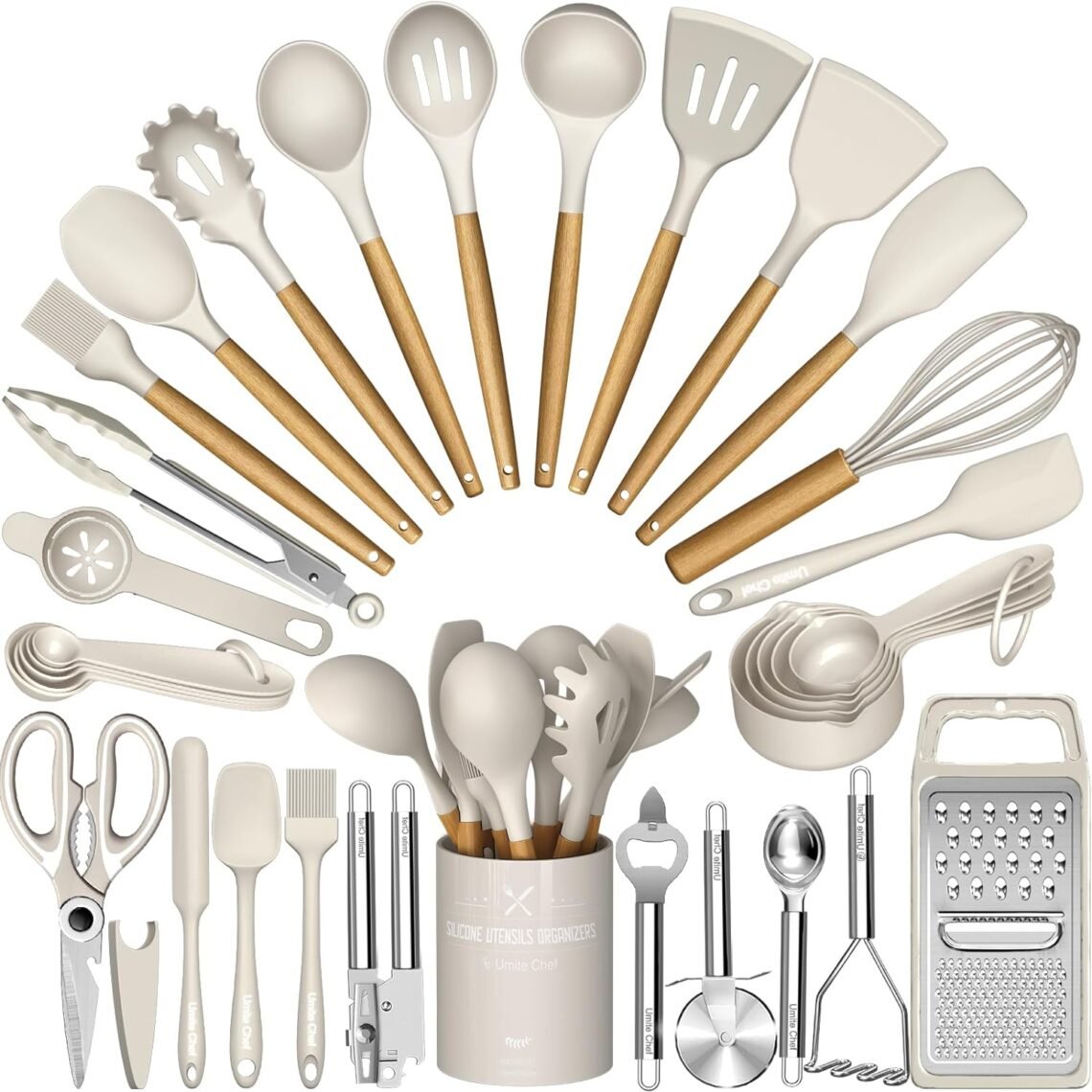
This 34-piece kitchen utensils set combines food-grade silicone heads with solid wooden handles, providing comprehensive cooking tool coverage from basic spatulas to specialised implements including grater, scissors, and kitchen tongs. Each silicone utensil incorporates internal stainless steel core construction preventing warping whilst maintaining flexibility. The set includes a stainless steel utensil holder featuring base drainage holes preventing water accumulation. This analysis examines the silicone-wood-steel composite construction, complete tool inventory, food safety certifications, heat resistance properties, cleaning requirements, and suitability as comprehensive starter kitchen set or gift option.
Contents
Complete 34-Piece Set Inventory
Understanding the complete tool inventory clarifies coverage and identifies potential gaps or redundancies in the collection.
Explicitly Stated Tools
Product description specifically identifies these implements:
- Slotted Spatula: Flat turner with slots allowing liquids/fats to drain
- Slotted Spoon: Spoon with perforations for straining whilst scooping
- Turner: Solid flat spatula for flipping and turning foods
- Pasta Server: Pronged/toothed utensil for serving spaghetti and long pasta
- Kitchen Tongs: Spring-loaded gripping tool for handling hot foods
- Grater: Surface with sharp perforations for shredding cheese, vegetables
- Scissors: Kitchen shears for cutting herbs, packaging, poultry
- Small Spatula: Mentioned as dishwasher-safe extra gadget
- Food Tongs: Referenced separately, possibly different size/style from kitchen tongs
- Utensil Holder: Storage container with drainage (counts as 1 piece)
Typical 34-Piece Set Composition
Whilst manufacturer doesn’t provide complete item-by-item breakdown, standard 34-piece kitchen utensil sets typically include:
Core Cooking Utensils (Silicone with Wooden Handles):
- Large slotted spatula/turner
- Solid spatula/turner
- Large cooking spoon
- Slotted spoon
- Soup ladle
- Pasta server/spaghetti spoon
- Potato masher
- Whisk (silicone-coated or full silicone)
- Basting brush
Additional Tools and Accessories:
- Kitchen tongs (possibly 2 sizes)
- Kitchen scissors/shears
- Grater (box grater or flat grater)
- Peeler
- Can opener
- Bottle opener
- Pizza cutter
- Measuring spoons set (typically 5-6 pieces)
- Measuring cups set (typically 4-5 pieces)
- Small spatulas or spreaders
- Egg separator or other specialty tools
- Utensil holder
Count Methodology: The “34 pieces” likely includes individual measuring spoons and cups counted separately (e.g., 4 measuring cups + 5 measuring spoons = 9 pieces toward total), plus approximately 20-25 primary cooking tools and accessories.
Comprehensive Coverage Assessment
The manufacturer positions this as providing “all the kitchen stuff you could possibly need to bring out your inner chef” and suitable as “great starter pack for a first apartment,” suggesting comprehensive coverage of:
- Basic cooking functions (stirring, flipping, serving, mixing)
- Specialised tasks (pasta serving, basting, whisking)
- Food preparation (grating, peeling, cutting)
- Measurement (cups and spoons for recipe precision)
- Storage organisation (holder with drainage)
Redundancy Consideration: Sets this size often include multiple spatulas or spoons in slightly different sizes/shapes, creating intentional redundancy allowing simultaneous multi-pot cooking or clean utensil availability whilst others await washing.
Tri-Material Construction: Silicone, Wood, Steel
The utensils employ three-material composite construction combining silicone functional heads, wooden handles, and internal stainless steel cores. Understanding each material’s role clarifies performance characteristics and maintenance requirements.
Silicone Head Construction
Food-Contact Surface: Silicone forms the working end of each utensil contacting food and cookware surfaces.
Heat Resistance: Food-grade silicone typically withstands temperatures from -40°C to +230°C, suitable for all cooking methods except direct flame contact.
Flexibility: Silicone provides flexibility enabling tools to conform to curved pan bottoms or bowl sides, improving scraping efficiency compared to rigid metal or wood tools.
Non-Stick Protection: Soft silicone prevents scratching non-stick coatings on cookware, addressing common concern with metal utensils damaging expensive non-stick pans.
Solid Wood Handle Construction
Heat Insulation: The manufacturer emphasises wooden handles are “anti scalding,” meaning they “completely prevent heat transfer during the cooking process.”
Natural Variation: Product notes state “each wooden handle has a slightly different color and texture” due to natural wood grain variations – not defect but characteristic of genuine wood.
Comfort and Grip: Described as “smooth and comfortable to the touch,” wood provides natural grip without requiring rubberised coatings.
Aesthetic Appeal: Vintage wooden handles create traditional appearance contrasting with modern silicone, suiting both contemporary and traditional kitchen aesthetics.
Wood Species: Specific wood type not disclosed. Common choices for kitchen utensils include beech, acacia, bamboo, or rubberwood based on availability, cost, and durability balance.
Internal Stainless Steel Core
Structural Support: The manufacturer explains stainless steel is “wrapped inside to maintain its shape and flexibility, ensuring no warping.”
Rigidity Balance: Steel core prevents excessive bending or permanent deformation whilst silicone exterior maintains sufficient flexibility for practical use.
Longevity: Reinforced construction extends tool lifespan compared to pure silicone utensils which may eventually sag, bend, or break under repeated stress.
Core Coverage: Steel likely extends through handle and into silicone head portion, though exact core length/configuration not specified.
One-Piece Silicone Design
Seamless Construction: Product emphasises “one-piece design eliminates any gaps where food can get trapped, making cleaning a breeze.”
Hygiene Advantage: Continuous silicone surface without seams, joints, or crevices prevents bacterial harbourage in hard-to-clean gaps common in multi-piece utensils.
Cleaning Efficiency: Smooth continuous surface enables quick wiping or rinsing without detailed scrubbing of joints or connection points.
Food Safety & BPA-Free Certification
The manufacturer makes explicit food safety claims requiring examination of certifications and material standards.
Food-Grade Silicone Claims
Primary Claim: “Each cooking utensil is made entirely of food-grade silicone, BPA-free and odorless.”
Food-Grade Definition: Food-grade silicone meets regulatory standards for direct food contact, meaning:
- Materials don’t leach harmful chemicals into food
- Silicone withstands repeated food contact without degrading
- Manufacturing process follows food safety protocols
- Product tested for migration of substances into food simulants
BPA-Free Certification
BPA Context: Bisphenol A (BPA) is industrial chemical used in some plastics and resins, associated with potential health concerns. Many consumers seek BPA-free products for food contact applications.
Silicone and BPA: Pure silicone (polysiloxane) chemistry doesn’t incorporate BPA. The BPA-free claim likely addresses:
- Consumer concerns about plastic kitchen tools
- Assurance no BPA-containing plastics used in any component
- Marketing differentiation from plastic utensil sets
Regulatory Context: In UK and EU, BPA use in food contact materials is regulated. BPA banned in baby bottles; restrictions exist for other applications. US FDA also regulates BPA use.
Odour-Free Claims
Initial Odour Caveat: Despite “odorless” claim, manufacturer provides first-use instructions: “It must be soaked for half an hour when it is used for the first time, and then exposed to the air for about 3 hours, the original smell of silica gel will disappear.”
Manufacturing Odour: New silicone products often carry slight odour from:
- Residual catalysts or additives from manufacturing
- Packaging materials or storage conditions
- Natural silicone scent from production process
Odour Elimination: Recommended soaking and airing process allows volatile compounds to dissipate, after which silicone should remain truly odourless during use.
Odour Retention Resistance: The manufacturer claims silicone “will not retain odors or colors like plastic kitchen utensils,” referring to long-term performance rather than initial state.
Food Safety Verification Limitations
Certification Absence: Product documentation doesn’t reference specific certifications such as:
- FDA approval (US)
- LFGB certification (Germany/EU)
- ISO food contact standards
- Independent laboratory testing results
Claim Verification: Without third-party certification documentation, food-grade and BPA-free claims represent manufacturer assertions rather than independently verified facts.
Practical Considerations: Reputable kitchen utensil manufacturers typically use genuinely food-safe silicone to avoid liability issues, though verification through certification provides additional assurance for cautious consumers.
Solid Wood Handle Design & Heat Resistance
Wooden handles provide thermal insulation and aesthetic appeal but introduce specific care requirements distinguishing these tools from all-silicone or metal-handled alternatives.
Heat Insulation Properties
Anti-Scalding Function: The manufacturer claims wooden handles “completely prevent heat transfer during the cooking process.”
Wood Thermal Properties:
- Low Thermal Conductivity: Wood conducts heat approximately 10-100 times slower than metals, depending on wood species and density
- Natural Insulation: Cellular structure of wood contains air pockets providing insulation barrier
- Safe Handling: Even when silicone head heats from contact with hot food or cookware, wooden handle remains cool enough for bare-hand gripping
Heat Exposure Limitations: Whilst handles resist heat transfer from typical cooking, prolonged direct exposure to heat sources (resting handle on hot stovetop, exposure to oven heat if left in pot) can eventually heat wood and potentially cause discolouration or damage.
Natural Wood Variation
Expected Differences: Product explicitly notes “each wooden handle has a slightly different color and texture.”
Natural Characteristics:
- Grain Patterns: Wood grain varies between individual pieces creating unique appearance
- Colour Variation: Natural colour differences from tree growth conditions, wood section used, or finishing process
- Texture Differences: Grain density and orientation affect surface feel
Quality vs Variation: Natural variation should not include cracks, splits, rough unfinished areas, or other defects – only aesthetic differences from natural wood properties.
Ergonomics and Comfort
Grip Quality: Described as “smooth and comfortable to the touch,” suggesting:
- Sanded and finished surface without splinters or rough spots
- Comfortable diameter for extended holding during cooking
- Natural grip without requiring rubberised coatings or texturing
Weight Balance: Solid wood handles add weight compared to hollow plastic alternatives, creating balanced feel preventing head-heavy tools that cause hand fatigue.
Aesthetic Appeal
Vintage Character: Wooden handles described as “vintage” create traditional appearance appealing to users preferring classic kitchen aesthetics over modern all-silicone or plastic tools.
Visual Warmth: Natural wood tones complement various kitchen colour schemes and provide organic visual warmth contrasting with industrial stainless steel or clinical white appliances.
Display-Worthy: Unlike plastic-handled tools often hidden in drawers, wood-handled utensils suit visible countertop storage in holder or hanging display.
Food-Grade Silicone Properties & Benefits
Understanding silicone material characteristics clarifies performance expectations, advantages, and limitations compared to traditional metal, wood, or plastic utensil materials.
Temperature Resistance Range
Typical Silicone Range: Food-grade silicone withstands temperatures from approximately -40°C to +230°C (-40°F to +450°F).
Cooking Applications:
- Stovetop Cooking: Suitable for all stovetop methods where utensil contacts food/cookware at typical cooking temperatures (100-200°C)
- Oven Use: Can withstand oven temperatures up to 230°C if utensil accidentally left in oven-safe cookware
- Freezer Safe: Low-temperature stability enables freezer storage of foods in silicone containers or with silicone tools
Limitations:
- Not suitable for direct flame contact (gas stovetop flame, open fire cooking)
- May degrade if repeatedly exposed to maximum temperature limits
- Wooden handles impose additional heat limitations despite silicone heat resistance
Non-Stick Cookware Protection
Primary Advantage: The manufacturer emphasises compatibility with “high-grade black pot” (non-stick cookware), addressing common concern about protecting non-stick coatings.
Scratch Prevention:
- Soft silicone (typically Shore A hardness 40-60) much softer than non-stick coatings (PTFE, ceramic)
- Flexes rather than gouging when pressure applied during cooking
- Extends non-stick cookware lifespan by preventing coating damage
- Eliminates need for entirely separate “non-stick safe” utensil set
Edge Design: Silicone utensil edges typically feature rounded or bevelled profiles rather than sharp metal edges, distributing force over wider area reducing coating stress.
Stain and Odour Resistance
Odour Resistance Claim: The manufacturer states silicone “will not retain odors or colors like plastic kitchen utensils.”
Staining Performance:
- Minimal Absorption: Non-porous silicone resists absorbing food colours better than porous plastics
- Stain Occurrence: Despite resistance, silicone can develop stains from highly pigmented foods (turmeric, tomato sauce, paprika) with prolonged contact
- Stain Removal: Most stains can be removed through soaking in bicarbonate of soda solution or exposure to sunlight
Odour Retention:
- Silicone resists absorbing cooking odours better than plastics which can retain garlic, onion, or fish smells
- Thorough washing typically eliminates any temporary odours from food contact
- Superior to nylon or plastic utensils notorious for permanent odour retention
Flexibility and Durability
Functional Flexibility:
- Spatula edges flex to conform to curved pan bottoms, improving food scraping efficiency
- Spoons bend slightly enabling easier serving from deep containers
- Flexibility allows gentle food handling without crushing delicate items
Structural Limitations: Pure silicone utensils without reinforcement may become too flexible, bending excessively under food weight or stirring resistance. The internal stainless steel core addresses this limitation.
Tear Resistance: Quality silicone resists tearing or cutting during normal use, though sharp edges or excessive force can damage material. Inspection for cuts or tears ensures food safety (damaged tools may harbour bacteria in cracks).
Internal Stainless Steel Core Function
The embedded stainless steel reinforcement represents crucial structural element differentiating quality silicone utensils from purely flexible alternatives.
Shape Retention Purpose
Manufacturer Explanation: “Stainless steel is wrapped inside to maintain its shape and flexibility, ensuring no warping.”
Structural Support:
- Prevents Drooping: Unreinforced silicone spatulas may droop when holding heavy foods, making serving difficult
- Maintains Working Angle: Core ensures spatula blade or spoon bowl retains intended angle rather than flexing perpendicular
- Resists Permanent Deformation: Prevents “memory” bending where repeated use in same direction permanently bends utensil
Flexibility Balance
Optimal Stiffness: Steel core provides rigidity whilst silicone exterior maintains beneficial flexibility:
- Spatula edges flex to conform to pans but blade doesn’t collapse
- Spoons maintain bowl shape whilst edges yield slightly for gentler serving
- Tools feel “substantial” rather than flimsy during use
Core Thickness Considerations: Wire gauge affects balance:
- Thicker Wire: More rigid, less flexible, very durable
- Thinner Wire: Retains some flexibility, lighter weight, potentially less durable under heavy use
Product doesn’t specify core thickness; users experience variability in rigidity-flexibility balance based on manufacturer’s design choices.
Heat Transfer Implications
Thermal Conductivity: Stainless steel conducts heat better than wood or silicone, creating potential heat transfer path from silicone head through steel core toward handle.
Mitigation Factors:
- Small Cross-Section: Thin wire core has limited surface area for heat conduction
- Silicone Insulation: Silicone surrounding core insulates steel, slowing heat transfer
- Wooden Handle: Wood provides final insulation barrier preventing heat reaching user’s hand
- Brief Contact: Typical cooking utensil contact with hot food/cookware is intermittent rather than continuous, limiting heat accumulation
Extended Heating Caution: Leaving utensil resting in hot pan for extended periods may eventually heat core enough to transfer warmth to handle. Remove utensils from cookware between stirring/serving actions.
Longevity Enhancement
Durability Improvement: Steel-reinforced silicone utensils typically outlast pure silicone alternatives:
- Reduced stress on silicone material from core support
- Prevention of fatigue-induced tearing at flex points
- Maintained functionality even if silicone shows minor wear
Expected Lifespan: Quality reinforced silicone utensils commonly provide 5-10+ years service with proper care, compared to 2-5 years for unreinforced silicone tools experiencing premature wear.
Utensil Holder with Drainage System
The included stainless steel holder provides organised storage with integrated drainage preventing water accumulation from wet utensils.
Holder Construction
Material: “High quality stainless steel” construction described as “will not rust or corrode.”
Design Purpose: “Help you organized your kitchen tools well,” consolidating scattered utensils into single convenient storage location.
Drainage System
Bottom Drainage Holes: Product emphasises “bottom of the holder is equipped with drainage holes to keep the stored kitchen utensils dry.”
Drainage Functionality:
- Freshly washed utensils drip water through base holes rather than pooling in holder bottom
- Prevents standing water that promotes bacterial growth and corrosion
- Facilitates air circulation for faster drying
- Described as “difficult to accumulate water” due to drainage design
Usage Requirement: Product specifies “allow to dry before storing in the holder,” suggesting complete drying preferred though drainage holes accommodate residual moisture.
Capacity and Organisation
34-Piece Accommodation: Holder sized to store complete utensil set, though exact dimensions not specified.
Vertical Storage: Utensils stand upright with handles pointing upward, heads resting on holder bottom:
- Space-efficient vertical orientation
- Easy identification and selection of needed tool
- Handles remain accessible for quick grasping
- Heads protected inside holder rather than exposed on countertops
Compartmentalisation: Product imagery suggests divided sections or sufficient internal space preventing utensils from tangling or jamming together.
Placement Considerations
Drainage Requirement: Holes in bottom require placement on:
- Drip tray or mat catching draining water
- Sink ledge where drainage drips into sink
- Countertop accepting of minor water exposure (verify surface water-resistance)
Proximity to Cooking: Position near stovetop or primary cooking area for convenient utensil access during food preparation.
Countertop Footprint: Large holder for 34 pieces occupies substantial counter space; verify adequate room before purchase.
Cleaning Requirements & Dishwasher Compatibility
Mixed-material construction creates specific cleaning requirements differing from all-silicone or all-metal utensils. Understanding proper care prevents damage and extends lifespan.
Dishwasher Compatibility Matrix
The manufacturer provides explicit guidance on dishwasher use:
Dishwasher Safety by Component
| Component | Dishwasher Safe? | Reasoning |
|---|---|---|
| Silicone Utensils with Wooden Handles | NO | “Due to the solid wooden handle, we don’t recommend soaking in water for a long time or dishwasher cleaning” |
| Small Spatula | YES | Explicitly stated as dishwasher safe (likely all-silicone construction) |
| Food Tongs | YES | Explicitly stated as dishwasher safe (likely all-silicone or metal) |
| Utensil Holder | YES | Stainless steel construction tolerates dishwasher |
Wooden Handle Care Requirements
Water Exposure Limitations:
- No Prolonged Soaking: Extended water immersion causes wood to absorb moisture, swell, crack, or split
- No Dishwasher: High heat and harsh detergents damage wood finish, dry out natural oils, cause warping or cracking
- Prompt Drying: After washing, dry wooden handles immediately preventing moisture absorption
Recommended Cleaning Method for Wood-Handled Utensils:
- Wash promptly after use before food residues harden
- Use warm water with mild washing-up liquid
- Wipe or briefly rinse (avoid submersion if possible)
- Pay attention to silicone-wood junction ensuring food doesn’t accumulate
- Rinse thoroughly removing all soap residue
- Dry immediately with clean towel, especially wooden handle
- Allow air-drying in upright position (handle up, head down for drainage)
- Store only when completely dry
Silicone Cleaning
Easy Cleaning: One-piece silicone design described as “making cleaning a breeze” due to absence of gaps trapping food.
Cleaning Methods:
- Hand Washing: Warm soapy water with sponge or cloth typically sufficient
- Stubborn Residue: Bicarbonate of soda paste or longer soaking in hot soapy water for stuck-on foods
- Grease Removal: Silicone resists grease absorption; thorough washing with degreasing washing-up liquid removes oils
- Stain Treatment: Soak in bicarbonate solution or expose to sunlight for natural bleaching of food stains
Stainless Steel Holder Cleaning
Dishwasher Safe: Stainless steel construction tolerates dishwasher cleaning.
Hand Washing Alternative:
- Wash with warm soapy water
- Scrub with sponge or brush removing any food residue from drainage holes
- Rinse thoroughly
- Dry to prevent water spots (though stainless steel tolerates air-drying without corrosion)
Drainage Hole Maintenance: Periodically verify holes remain clear, using pipe cleaner or small brush if blockages develop.
First-Use Preparation & Odour Elimination
The manufacturer provides specific first-use instructions addressing initial silicone odour, requiring preparation before cooking use.
Initial Odour Context
Manufacturing Residue: Despite “odorless” marketing claim, product acknowledges “original smell of silica gel” present initially.
Odour Sources:
- Residual catalysts or chemicals from silicone curing process
- Volatile organic compounds (VOCs) from manufacturing
- Packaging materials or storage conditions
- Natural silicone scent from production
Safety Context: Initial odour from food-grade silicone represents manufacturing residue rather than harmful contamination, but proper preparation ensures complete removal before food contact.
Recommended Preparation Procedure
The manufacturer specifies: “It must be soaked for half an hour when it is used for the first time, and then exposed to the air for about 3 hours, the original smell of silica gel will disappear.”
Step-by-Step First-Use Process:
- Initial Inspection: Remove packaging, inspect utensils for damage or defects
- Warm Water Soak (30 Minutes):
- Fill large bowl or sink with warm (not boiling) water
- Add small amount of washing-up liquid (optional but recommended)
- Submerge silicone portions of utensils completely
- Handle Consideration: Avoid prolonged wooden handle submersion; focus soaking on silicone heads
- Allow 30-minute soak dissolving and removing manufacturing residues
- Rinse Thoroughly:
- Rinse each utensil under running water
- Ensure all soap and loosened residues removed
- Air Exposure (3 Hours):
- Place utensils in well-ventilated area
- Separate items allowing air circulation around each piece
- Allow 3 hours airing enabling volatile compounds to dissipate
- Outdoor airing (weather permitting) accelerates process
- Sniff Test:
- After airing, smell utensils verifying odour elimination
- If odour persists, repeat soaking and airing process
- Final Wash:
- Wash utensils again with warm soapy water
- Rinse thoroughly
- Dry completely
- Utensils now ready for cooking use
Alternative Preparation Methods
Boiling Water Method (for non-wooden items):
- Submerge silicone in boiling water for 5-10 minutes
- Accelerates odour compound release
- Not suitable for wood-handled utensils – heat and water damage wood
- Only applicable to all-silicone items (small spatula, tongs if silicone)
Bicarbonate Soak:
- Add 2-3 tablespoons bicarbonate of soda to warm water
- Soak 30-60 minutes
- Bicarbonate neutralises odours more effectively than water alone
Vinegar Rinse:
- Rinse utensils in diluted white vinegar (1:1 with water)
- Vinegar’s acidity helps neutralise odours
- Rinse thoroughly with water after vinegar treatment
Non-Stick Cookware Protection
A primary value proposition centres on protecting non-stick cookware from scratching and damage. Understanding compatibility clarifies suitability for various pan types.
Non-Stick Coating Types
Compatible Coatings:
- PTFE (Teflon): Traditional non-stick coating vulnerable to metal utensil scratching
- Ceramic Non-Stick: Harder than PTFE but still damaged by metal utensils
- Hard-Anodised Aluminium: Durable coating benefiting from silicone protection
- Enamelled Cast Iron: Scratch-resistant but silicone prevents enamel chipping
Protection Mechanism: Soft silicone (Shore A 40-60 hardness) significantly softer than all cookware coatings, flexing rather than scratching when pressure applied during stirring, scraping, or flipping.
Manufacturer Emphasis
“Match Your High-Grade Black Pot”: Marketing specifically targets users with quality non-stick cookware (often black-finished) who want to protect investment through appropriate utensil selection.
Coating Lifespan Extension: Using silicone instead of metal utensils can extend non-stick coating functional life from typical 2-3 years to 5-7+ years by preventing scratches that compromise non-stick performance and accelerate coating degradation.
Usage Best Practices
Gentle Application:
- Avoid excessive force when scraping or stirring
- Use appropriate-sized utensils for pan dimensions
- Don’t use utensils to chip or pry stuck foods (soak pan instead)
Temperature Awareness:
- Don’t leave silicone utensils resting on hot stovetop surfaces
- Remove from pans between stirring to prevent unnecessary heat exposure
- Verify silicone temperature rating (typically 230°C) not exceeded
Compatibility with Other Cookware
Cast Iron (Un-Enamelled):
- Silicone safe for cast iron though metal utensils also acceptable
- Gentler on seasoning layer than harsh metal scraping
- Wooden handles complement traditional cast iron aesthetic
Stainless Steel:
- No scratch concerns with durable stainless
- Silicone flexibility aids in scraping curved pan bottoms
- Perfectly compatible
Copper:
- Protects decorative copper surfaces from scratching
- Prevents tarnish transfer to food
- Compatible
Gift-Giving Context & Applications
The manufacturer positions this extensively as gift item, emphasising presentation and comprehensive coverage for gift-giving scenarios.
Stated Gift Applications
“Great Presents Set”: Product explicitly marketed for:
- House Warming Presents: Comprehensive set for new homeowners establishing kitchens
- Wedding Presents: Traditional gift for newlyweds setting up first shared household
- Mother’s Day Presents: Thoughtful practical gift for mothers who cook
- Holiday Presents: Christmas, birthdays, or other gift-giving occasions
- “Anyone else on your presents list”: Versatile gift suitable for various recipients
Gift-Worthiness Factors
Comprehensive Coverage: 34-piece count creates perception of generous, complete gift rather than token single-item present.
Starter Set Positioning: Described as “great starter pack for a first apartment,” ideal for:
- Recent graduates moving to first independent housing
- Students setting up flats
- Young professionals establishing homes
- Anyone transitioning from furnished to unfurnished accommodation
Ready-to-Use: Includes holder and complete tool set meaning recipient has immediate functional cooking capability without additional purchases.
Visual Presentation: Wooden handles and organised set create attractive appearance suitable for gift presentation (verify if special gift packaging included).
Ideal Gift Recipients
Moving or Relocating Individuals:
- “If you moving or just need a new set of cooking utensils highly recommended”
- Addresses immediate need when establishing new kitchen
- Eliminates need for recipient to individually purchase dozens of tools
Cooking Enthusiasts:
- Appeals to those who enjoy cooking and appreciate quality tools
- Upgrade from worn or mismatched utensil collections
- Complements investment in quality cookware
Non-Stick Cookware Owners:
- Particularly valuable for recipients with non-stick pans needing appropriate utensils
- Protects their cookware investment
- Demonstrates thoughtful gift selection matching their needs
Gift Presentation Suggestions
Packaging Verification: Confirm whether product arrives in gift-ready packaging or requires separate gift wrapping.
Enhancement Options:
- Include recipe book complementing new utensils
- Add kitchen towels or oven gloves creating comprehensive kitchen gift basket
- Pair with quality cookware piece (frying pan, saucepan) for substantial combined gift
Complete Technical Specifications
Complete Product Specifications
| Specification Category | Details |
|---|---|
| Set Composition | 34 pieces including cooking utensils, accessories, and storage holder |
| Explicitly Named Tools | Slotted spatula, slotted spoon, turner, pasta server, kitchen tongs, grater, scissors, small spatula, food tongs, measuring spoons, measuring cups, utensil holder |
| Primary Material (Heads) | Food-grade silicone, BPA-free |
| Handle Material | Solid wood (species not specified) |
| Internal Reinforcement | Stainless steel core for shape retention |
| Holder Material | Stainless steel with corrosion resistance |
| Heat Resistance | Silicone: typically -40°C to +230°C (specific rating not stated) |
| Non-Stick Safe | Yes – silicone protects all non-stick coatings |
| Dishwasher Safe | Partial – holder, small spatula, tongs YES; wood-handled utensils NO |
| Holder Drainage | Bottom drainage holes prevent water accumulation |
| First Use Prep | 30-minute soak + 3-hour airing to eliminate manufacturing odour |
| Cleaning Method | Hand wash wood-handled utensils; dishwasher safe for select pieces |
| Colour | Silicone colour not specified (likely black or grey based on imagery); natural wood handles with variation |
| Warranty | Not specified in provided documentation |
| Target Applications | Home cooking, first apartments, gift-giving, non-stick cookware use |
Estimated Complete Tool Inventory
Based on typical 34-piece kitchen utensil set composition. Exact contents should be verified with seller.
| Category | Likely Included Tools | Estimated Piece Count |
|---|---|---|
| Spatulas/Turners | Slotted spatula, solid spatula, small spatula, flexible turner | 3-4 pieces |
| Spoons | Large cooking spoon, slotted spoon, serving spoon, soup ladle | 3-4 pieces |
| Pasta/Serving | Pasta server, spaghetti spoon | 1-2 pieces |
| Mixing/Prep | Whisk, potato masher, basting brush | 2-3 pieces |
| Tongs | Kitchen tongs (possibly 2 sizes), food tongs | 2-3 pieces |
| Cutting/Shearing | Kitchen scissors/shears, pizza cutter | 2 pieces |
| Prep Tools | Grater, peeler, can opener, bottle opener | 3-4 pieces |
| Measuring Spoons | Set of 4-6 measuring spoons (various sizes) | 4-6 pieces |
| Measuring Cups | Set of 4-5 measuring cups (various volumes) | 4-5 pieces |
| Storage | Utensil holder with drainage | 1 piece |
| TOTAL | Comprehensive cooking tool collection | 34 pieces |
Essential Care Summary
Do These Things
- Complete first-use preparation (30-min soak + 3-hour airing) before cooking
- Hand wash wood-handled utensils immediately after use
- Dry wooden handles thoroughly after washing
- Store utensils completely dry in holder
- Use gentle pressure when cooking – silicone flexibility provides scraping efficiency
- Remove utensils from hot pans between uses
- Clean holder drainage holes periodically
- Inspect silicone for cuts or tears replacing damaged utensils
- Use bicarbonate soak for stubborn stains on silicone
- Dishwasher-clean holder, small spatula, and tongs if convenient
Never Do These Things
- Put wood-handled utensils in dishwasher
- Soak wooden handles for extended periods
- Expose wooden handles to high heat or direct flames
- Use abrasive scrubbers on silicone (can scratch or tear)
- Leave silicone utensils in direct contact with heat sources
- Store wet utensils in holder (promotes bacterial growth)
- Use metal implements alongside silicone when metal suffices (wear differentiation)
- Expose silicone to temperatures exceeding rated limits
- Use damaged utensils with cuts or tears (bacteria harbour in cracks)
- Expect colour consistency in natural wood handles (variation is normal)
Analysis Summary
This 34-piece kitchen utensils set provides comprehensive tool coverage spanning basic cooking implements to specialised accessories including measuring equipment and preparation tools. The tri-material construction combining food-grade silicone heads, solid wooden handles, and internal stainless steel reinforcement creates functional balance between flexibility, structural integrity, and heat insulation whilst enabling non-stick cookware protection.
The silicone-wood combination addresses common cookware protection needs through soft food-contact surfaces preventing scratches on expensive non-stick coatings, potentially extending pan lifespan by years through elimination of metal utensil damage. Internal steel cores prevent excessive flexing maintaining tool functionality under load whilst silicone exterior preserves beneficial flexibility for pan conforming and gentle food handling.
Wooden handles provide genuine thermal insulation preventing heat transfer from cooking operations to user hands, addressing common complaint about all-silicone or metal-handled tools becoming uncomfortably hot. Natural wood variation in colour and grain creates individual character though introduces care requirements incompatible with dishwasher cleaning or prolonged water exposure necessitating immediate hand-washing and drying protocols.
The included stainless steel holder with base drainage holes provides organised storage preventing countertop clutter whilst facilitating utensil drying through water drainage and air circulation. This addresses bacterial growth concerns associated with storing perpetually damp utensils in solid-bottom containers, though drainage holes require appropriate placement over drip tray or sink to avoid countertop water damage.
First-use preparation requirements including 30-minute soaking and 3-hour airing represent additional setup step before cooking use, addressing manufacturing odour elimination. This procedure clarifies that “odourless” marketing claim applies to properly prepared tools rather than immediate out-of-package state, requiring user action to achieve advertised odour-free performance.
The comprehensive 34-piece count creates substantial gift-worthy presentation suitable for housewarming, wedding, or holiday gifting scenarios, particularly targeting recipients establishing first kitchens or upgrading from worn utensil collections. The manufacturer’s “starter pack for first apartment” positioning accurately reflects complete coverage enabling immediate cooking capability without additional tool purchases.
Mixed dishwasher compatibility requiring hand-washing for wood-handled implements whilst allowing machine cleaning for select all-silicone or metal pieces creates maintenance inconsistency. Users seeking entirely dishwasher-safe tool sets should consider all-silicone alternatives, whilst those valuing wooden aesthetics and heat insulation will accept hand-washing requirements as worthwhile trade-off.
Food-grade silicone and BPA-free claims provide food safety assurance though absence of specific certification references (FDA, LFGB, ISO) prevents independent verification of material standards. Reputable manufacturers typically use genuinely food-safe materials avoiding liability, though documented certifications offer additional confidence for cautious consumers.
The set suits households requiring comprehensive tool collection, users with non-stick cookware needing appropriate utensils, individuals establishing first independent kitchens, and gift-givers seeking substantial practical presents. The combination of traditional wooden aesthetics with modern silicone functionality appeals to users wanting visual warmth without sacrificing cookware protection or functional performance.
Limitations include hand-washing requirement for majority of set, first-use preparation necessity, lack of specification regarding exact tool inventory composition, and absence of documented certifications or warranty information. Users should verify complete contents list with seller before purchase ensuring specific needed tools are included in 34-piece count.
Product Availability
This 34-piece kitchen utensils set with wooden handles and silicone heads is available through various retailers including Amazon UK. Product specifications, colour options, and exact tool composition may vary by seller and region. Verify complete contents list before purchase to ensure specific needed tools are included.
As an Amazon Associate I earn from qualifying purchases.
Product specifications and availability subject to change. Verify current details, complete tool inventory, warranty terms, and care instructions with retailer before purchase. Remember to complete first-use preparation before cooking use.