Freshware Bamboo Cutting Boards: A Comprehensive Product Analysis


Executive Summary
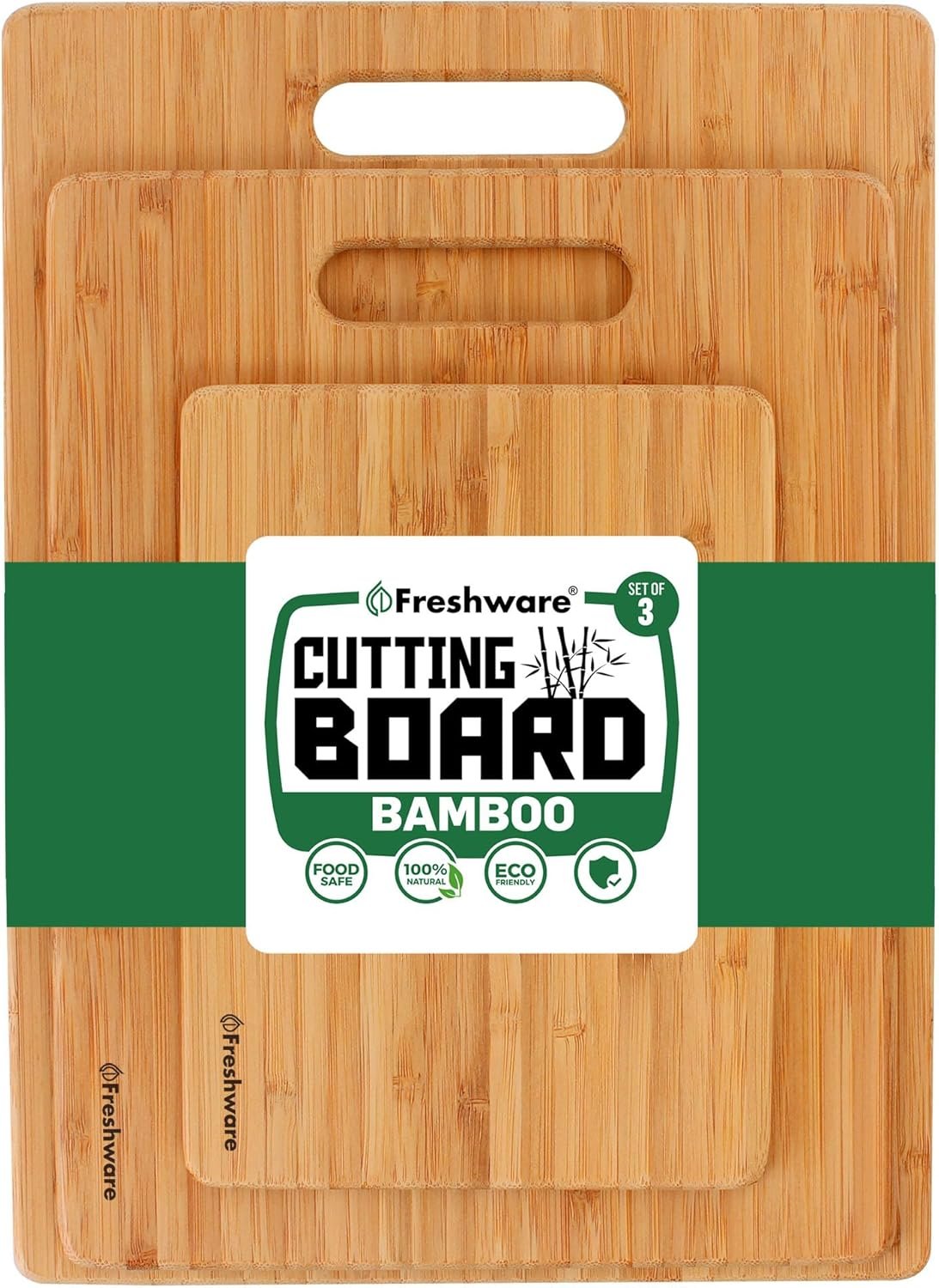
This three-piece bamboo cutting board set from Freshware presents a graduated sizing approach to kitchen food preparation surfaces. The collection comprises large, medium, and small boards constructed from laminated bamboo strips, targeting households seeking alternatives to traditional plastic or glass cutting surfaces. This analysis examines construction methodology, material characteristics, dimensional specifications, and practical application scenarios without subjective performance assessments.
Contents
Product Composition & Specifications
The Freshware bamboo cutting board collection consists of three individual boards manufactured from compressed bamboo laminate material. Each unit features integrated handle cutouts positioned along one edge, facilitating single-handed transport between preparation and cleaning areas.
The set includes boards measuring approximately 30cm x 20cm, 23cm x 15cm, and 18cm x 13cm respectively, though precise dimensions may exhibit slight variance between production batches. Thickness specifications remain consistent across all three sizes at approximately 8-10mm, distinguishing these from thicker bamboo board variants available in the marketplace.
Package Contents
Each retail package contains:
- One large cutting board (approximately 30cm x 20cm x 9mm)
- One medium cutting board (approximately 23cm x 15cm x 9mm)
- One small cutting board (approximately 18cm x 13cm x 9mm)
- Manufacturer documentation
The boards arrive individually wrapped in protective film within cardboard packaging. No supplementary accessories such as mineral oil, conditioning wax, or storage solutions accompany the core product offering.
Technical Specifications Summary
| Specification | Details |
|---|---|
| Material Composition | Laminated bamboo strips with adhesive bonding |
| Set Configuration | Three boards in graduated sizes |
| Thickness Range | 8-10mm across all units |
| Surface Treatment | Sanded finish with protective coating |
| Handle Design | Integrated cutout groove |
| Edge Profile | Rounded corners with smooth finishing |
| Recommended Cleaning | Hand washing with immediate drying |
| Manufacturing Origin | China |
Material Construction & Manufacturing Process
Bamboo cutting boards utilise a laminated construction methodology rather than solid material blocks. The manufacturing process involves several distinct stages transforming raw bamboo culms into finished kitchen surfaces.
Bamboo Processing Stages
Raw bamboo stalks undergo initial processing where the cylindrical culms are split lengthwise into strips. These strips receive dimensional milling to achieve uniform thickness and width specifications required for lamination. The natural outer bamboo skin typically remains on one side of finished strips, creating the characteristic grain pattern visible on completed boards.
Following dimensional processing, bamboo strips undergo treatment applications designed to enhance moisture resistance and provide antimicrobial properties. The specific chemical treatments employed in this product line remain undisclosed in manufacturer documentation, though food-grade mineral oil applications represent common industry practice.
Lamination Assembly
Processed bamboo strips are arranged in parallel orientation with adhesive application between layers. The assembled strips undergo compression under controlled temperature and pressure conditions, bonding individual pieces into unified board blanks. This lamination process creates the multi-layer structure characteristic of bamboo cutting board construction.
The adhesive formulations employed in bamboo board manufacturing must balance bonding strength with food safety requirements. Formaldehyde-free adhesives have become standard in food-contact bamboo products, though specific adhesive chemistry specifications are not provided in product documentation.
Final Machining Operations
Following lamination curing, board blanks receive final machining to achieve specified dimensions. Edge profiling creates the rounded corner treatment reducing sharp edges and potential splintering. Handle cutouts are routed through board thickness at one end, with edges receiving similar rounding treatment for comfortable grip surfaces.
Surface sanding smooths both faces to food-preparation grade finish levels. Final protective coating application provides the factory-fresh appearance and initial moisture resistance properties observed on new boards.
Manufacturing Context
Bamboo processing for cutting boards represents a segment of the broader bamboo products industry. China maintains dominant market position in bamboo product manufacturing due to extensive bamboo forest resources and established processing infrastructure. Manufacturing facilities typically integrate multiple production stages from raw material processing through final finishing operations.
Dimensional Analysis & Size Applications
The three-board configuration addresses different food preparation scenarios through dimensional variation. Understanding the practical applications suited to each size category assists in determining set utility for specific kitchen workflows.
Large Board Specifications
The largest board measuring approximately 30cm x 20cm provides 600 square centimetres of working surface. This dimension accommodates typical chef’s knife blade lengths of 20-25cm with adequate clearance for standard rocking motion during mincing and dicing operations.
The surface area handles preparation tasks including:
- Multiple vegetable chopping for recipes requiring varied ingredients
- Protein slicing operations for portions serving 2-4 people
- Sandwich assembly with space for multiple components
- Serving board functions for cheese arrangements or charcuterie displays
The 9mm thickness provides limited structural rigidity, creating potential flex when downward cutting pressure exceeds approximately 5-7kg force. This characteristic distinguishes the boards from thicker variants measuring 15-20mm that resist flexing under typical cutting loads.
Medium Board Applications
At approximately 23cm x 15cm, the medium board provides 345 square centimetres of surface area. This intermediate size suits single-ingredient preparation tasks where the larger board’s footprint exceeds requirements whilst the smallest board offers insufficient workspace.
Typical applications include:
- Individual fruit preparation for snacks or garnishes
- Herb chopping for recipe components
- Single vegetable slicing for sandwich additions
- Small serving applications for individual portions
The reduced surface area compared to the large board decreases storage space requirements, making this size practical for kitchens with limited drawer or cabinet capacity.
Small Board Utility
The smallest board at approximately 18cm x 13cm provides 234 square centimetres of working surface. This compact dimension limits practical applications to minimal preparation tasks requiring restricted workspace.
Suitable uses include:
- Garlic clove mincing
- Citrus slicing for beverages
- Small garnish preparation
- Condiment arrangement for serving
The limited surface area prevents this board from functioning as a primary preparation surface, positioning it instead as a supplementary workspace for specific small-scale tasks.
Dimensional Comparison & Application Guide
| Board Designation | Approximate Dimensions | Surface Area | Primary Applications |
|---|---|---|---|
| Large | 30cm x 20cm x 9mm | 600 sq cm | Multi-ingredient meal preparation, protein slicing, serving board |
| Medium | 23cm x 15cm x 9mm | 345 sq cm | Single ingredient prep, fruit cutting, herb chopping |
| Small | 18cm x 13cm x 9mm | 234 sq cm | Minimal prep tasks, garnish preparation, condiment serving |
Surface Characteristics & Finishing
The bamboo surface presents specific textural and visual characteristics resulting from the lamination construction method and finishing processes applied during manufacturing.
Visual Appearance
The boards display linear grain patterns created by the parallel orientation of bamboo strips during lamination assembly. Natural colour variation between individual bamboo strips creates subtle tonal differences across board surfaces, with colours ranging from light tan to darker amber tones depending on bamboo maturity at harvest.
The factory-applied protective coating provides a semi-gloss surface appearance when new. This coating serves multiple functions including moisture resistance enhancement, surface smoothing, and initial antimicrobial properties. Coating composition specifications are not disclosed in product documentation.
Surface Texture
Factory sanding operations create smooth surface texture suitable for food contact applications. The bamboo grain structure remains perceptible through tactile examination, with slight variations in surface elevation between adjacent bamboo strips measuring typically less than 0.5mm.
The coating application fills minor surface irregularities present in sanded bamboo, creating more uniform texture than uncoated bamboo surfaces would present. This smoothing effect facilitates easier cleaning by reducing microscopic crevices where food particles might lodge.
Edge Treatment
Board edges receive rounded profile treatment during final machining operations. This rounding eliminates sharp 90-degree angles that could splinter or create uncomfortable contact during handling. Corner radii typically measure 3-5mm, providing adequate edge softening whilst maintaining defined board perimeter.
The handle cutout edges receive similar rounding treatment, creating smooth gripping surfaces. Handle opening dimensions measure approximately 3-4cm in width, accommodating typical adult hand dimensions for single-handed carrying.
Maintenance Protocols & Care Requirements
Bamboo cutting boards require specific maintenance procedures to preserve functional properties and extend service life. These protocols differ from plastic board maintenance due to bamboo’s organic composition and laminated construction.
Daily Cleaning Procedures
Immediate cleaning following food preparation prevents organic matter from penetrating bamboo surface layers. Recommended cleaning protocol involves:
- Removing loose food debris through scraping or brushing
- Washing with warm water and mild dish soap using soft cloth or brush
- Thorough rinsing to remove all soap residue
- Immediate drying with absorbent towel
- Standing board vertically or propping at angle for complete air drying
Prolonged water submersion should be avoided as moisture penetration into lamination adhesive layers may compromise structural integrity. Dishwasher use is not recommended due to high water temperature and extended moisture exposure exceeding hand-washing durations.
Stain Treatment Methods
Strongly pigmented ingredients such as beetroot, turmeric, and berries can create surface staining on bamboo. Several treatment approaches address these discolourations:
Bicarbonate of Soda Method: Creating paste consistency by mixing bicarbonate of soda with minimal water, applying to stained areas, allowing 10-15 minute contact time, then scrubbing with brush or rough cloth before thorough rinsing.
Lemon Juice Application: Applying fresh lemon juice directly to stained surfaces, allowing 15-20 minute contact time for natural bleaching action, then washing and rinsing thoroughly.
White Vinegar Solution: Diluting white vinegar with equal parts water, applying to stained areas with cloth, allowing brief contact time, then rinsing thoroughly to remove vinegar odour.
Conditioning Requirements
The factory protective coating degrades over time through repeated washing and cutting action. Once coating wears through, exposed bamboo requires periodic conditioning to maintain moisture resistance and prevent excessive drying.
Food-grade mineral oil represents the standard conditioning agent for wooden and bamboo cutting surfaces. Application procedure involves:
- Ensuring board is completely clean and dry
- Applying generous mineral oil coating to all board surfaces
- Allowing 4-6 hours for oil absorption
- Wiping excess oil with clean cloth
- Allowing additional 24 hours before food preparation use
Conditioning frequency depends on usage intensity, with monthly treatments typically adequate for boards in regular service. Boards exhibiting dry appearance or absorbing water droplets rapidly indicate conditioning requirement.
Critical Maintenance Notes
Water Exposure: Extended water submersion or dishwasher use may cause warping or delamination due to differential moisture absorption between bamboo strips and adhesive layers.
Heat Exposure: Avoid placing boards near heat sources or in direct sunlight during drying, as rapid moisture removal can cause warping or cracking.
Storage Environment: Store in environments with moderate humidity levels. Extremely dry conditions may cause board shrinkage and cracking, whilst excessive humidity promotes mould growth.
Bamboo Material Properties
Understanding bamboo’s fundamental material characteristics provides context for cutting board performance capabilities and limitations compared to alternative materials.
Botanical Classification
Despite wood-like appearance and applications, bamboo belongs to the grass family (Poaceae subfamily Bambusoideae) rather than tree classification. This botanical distinction creates structural differences from hardwoods at the cellular level.
Bamboo achieves harvest maturity in 3-5 years compared to hardwood trees requiring 20-50+ years for timber harvest. This rapid growth cycle forms the basis for bamboo’s environmental sustainability positioning in consumer products.
Physical Properties
Bamboo exhibits moderate hardness on the Janka hardness scale, measuring approximately 1,380-1,410 pounds-force depending on species and processing methods. This positions bamboo between softer woods like pine (870 lbf) and harder species like hard maple (1,450 lbf).
The material demonstrates anisotropic properties, meaning physical characteristics vary depending on direction relative to bamboo fibre orientation. Bamboo shows greater strength along fibre length compared to cross-grain direction, influencing how boards resist cutting impacts and warping stresses.
Moisture Behaviour
Bamboo’s organic cellulose composition makes it hygroscopic, meaning the material absorbs and releases moisture in response to environmental humidity levels. This characteristic creates dimensional changes as bamboo expands with moisture absorption and contracts during drying.
Laminated bamboo construction amplifies moisture-related challenges compared to solid wood. Individual bamboo strips may respond differently to moisture changes depending on grain orientation and adhesive penetration, creating differential expansion forces that can manifest as warping or delamination.
Antimicrobial Properties
Research into bamboo’s natural antimicrobial properties remains ongoing, with some studies suggesting certain bamboo species contain compounds exhibiting antibacterial activity. However, the processing methods employed in cutting board manufacturing may alter or eliminate these natural properties.
The protective coatings and treatments applied during manufacturing often include antimicrobial agents separate from bamboo’s intrinsic properties. Product documentation does not specify whether antimicrobial properties derive from bamboo itself or applied treatments.
Practical Kitchen Applications
Bamboo cutting boards serve various functions within kitchen environments beyond basic cutting surface applications. Understanding these diverse use cases helps determine set utility.
Food Preparation Functions
The primary application involves providing sanitary surface for knife-based food preparation activities. Suitable tasks include:
- Vegetable chopping, dicing, and mincing operations
- Fruit slicing and sectioning
- Bread cutting and sandwich assembly
- Herb and garlic processing
- Cooked protein slicing for serving
- Pastry rolling surface for some applications
Bamboo’s moderate hardness creates less knife edge degradation compared to glass, ceramic, or composite surfaces that rapidly dull blade edges. However, bamboo provides less blade-friendly surface than end-grain hardwood boards specifically engineered to minimize edge dulling.
Serving Applications
The natural bamboo aesthetic makes these boards suitable for direct serving applications where visual presentation matters. Common serving uses include:
- Cheese board presentations with fruit and accompaniments
- Charcuterie arrangements for entertaining
- Bread serving at table
- Appetizer platter base
- Individual portion presentations
The handle cutout facilitates passing boards around dining tables without guests handling food contact surfaces directly. However, the relatively thin board profile and lightweight construction may feel less substantial compared to thicker presentation boards marketed specifically for serving purposes.
Cross-Contamination Prevention
The three-board set configuration enables dedicated assignment of individual boards to specific food categories, reducing cross-contamination risks between raw proteins and ready-to-eat ingredients. Common assignment strategies include:
- Large board for raw meat and poultry
- Medium board for fresh vegetables and fruits
- Small board for ready-to-eat items like bread and cheese
This dedicated-use approach requires colour coding or labelling systems to distinguish boards, as the natural bamboo appearance provides no inherent visual differentiation between units.
Storage Considerations
Proper storage methods preserve board condition between uses whilst minimising kitchen space consumption.
Vertical Storage Methods
Storing boards vertically on edge facilitates air circulation around all surfaces, promoting complete drying and reducing mould growth risks. Vertical storage options include:
- Dedicated cutting board racks with slotted dividers
- Magazine file holders repurposed for board storage
- Cabinet door-mounted racks utilising unused vertical space
- Drawer dividers creating vertical board slots
The 8-10mm thickness allows multiple boards to store in relatively compact horizontal space when positioned vertically. The three-board set requires approximately 30-35mm of horizontal space when nested together vertically.
Horizontal Stacking
Horizontal stacking conserves vertical cabinet space but requires ensuring boards dry completely before stacking to prevent moisture trapping between surfaces. Placing thin spacers between stacked boards promotes air circulation whilst maintaining compact storage configuration.
The lightweight construction allows stacking multiple board sets without excessive weight accumulation. However, placing heavy items atop horizontally stored boards may cause warping or flexing, particularly with the thinner construction of these units.
Display Storage
The natural bamboo aesthetic makes these boards suitable for open display storage. Options include:
- Wall-mounted wooden pegs creating decorative board display
- Countertop plate stands exhibiting largest board
- Open shelving arrangements incorporating boards as visual elements
Display storage keeps boards readily accessible whilst contributing to kitchen décor. However, exposure to cooking moisture and grease accumulation requires more frequent cleaning compared to enclosed cabinet storage.
Material Comparisons with Alternatives
Bamboo represents one option among several cutting board material categories, each presenting distinct characteristics affecting functionality and maintenance requirements.
Bamboo Versus Plastic
Plastic cutting boards, typically manufactured from polypropylene or polyethylene, offer several contrasting properties to bamboo:
Moisture Resistance: Plastic demonstrates superior moisture resistance, tolerating dishwasher cleaning and extended water exposure without warping or delamination risks that affect bamboo.
Knife Edge Impact: Both materials fall in moderate range for knife edge preservation, though specific plastic formulations and bamboo hardness variations create performance differences within each category.
Surface Scoring: Plastic surfaces show knife scoring similarly to bamboo, with accumulated cuts creating grooves harbouring bacteria over extended use.
Environmental Considerations: Bamboo derives from renewable plant resources with relatively rapid regrowth cycles, whilst plastic originates from petroleum feedstocks. However, bamboo board disposal presents organic waste whilst plastic may persist in landfill environments.
Bamboo Versus Traditional Hardwoods
Hardwoods like maple, walnut, and cherry represent traditional cutting board materials offering different characteristics:
Construction Methods: Quality hardwood boards often employ end-grain construction where wood fibres orient vertically, creating self-healing properties as knife edges push between fibres rather than severing them. Bamboo boards typically use edge-grain lamination without this self-healing characteristic.
Thickness Standards: Traditional hardwood boards commonly measure 2.5-5cm thickness compared to the 8-10mm specification of these bamboo boards, providing greater structural rigidity and resisting flex during cutting operations.
Material Costs: Hardwood boards generally command higher retail pricing than bamboo alternatives, reflecting longer tree growth cycles and often more labour-intensive manufacturing processes.
Bamboo Versus Composite Materials
Modern composite cutting surfaces manufactured from wood fibre and resin combinations present another alternative category:
Moisture Stability: Quality composites often demonstrate superior dimensional stability under moisture exposure compared to natural bamboo, resisting warping through engineered material formulations.
Maintenance Requirements: Some composite materials tolerate dishwasher cleaning and require less conditioning than bamboo surfaces demanding regular mineral oil application.
Aesthetic Characteristics: Bamboo provides natural grain patterns and organic appearance whilst composites often present more uniform industrial appearance, influencing suitability for serving applications.
Cutting Board Material Properties Comparison
| Property | Laminated Bamboo | Plastic (HDPE) | End-Grain Hardwood | Composite Materials |
|---|---|---|---|---|
| Dishwasher Safe | Not recommended | Generally yes | Not recommended | Varies by product |
| Knife Edge Preservation | Moderate | Moderate | Excellent (end-grain) | Moderate to good |
| Moisture Resistance | Requires maintenance | Excellent | Requires maintenance | Good to excellent |
| Warping Susceptibility | Moderate to high | Low | Low (quality examples) | Low |
| Conditioning Needs | Regular oiling required | None | Regular oiling required | Minimal to none |
| Material Sustainability | Renewable (3-5 year cycle) | Petroleum-based | Renewable (20-50 year cycle) | Mixed composition |
Complete Technical Specifications
This section consolidates detailed technical information regarding construction, materials, and physical properties for reference purposes.
Material Composition Details
- Primary Material: Laminated bamboo strips in parallel orientation
- Bamboo Species: Not specified in product documentation (likely Moso bamboo – Phyllostachys edulis)
- Adhesive Type: Not disclosed (industry standard typically formaldehyde-free food-safe adhesives)
- Surface Treatment: Proprietary protective coating (composition not specified)
- Antimicrobial Treatment: Present but specific agents not disclosed
Physical Dimensions
Large Board:
- Length: Approximately 30cm (±2mm tolerance)
- Width: Approximately 20cm (±2mm tolerance)
- Thickness: 8-10mm
- Handle Cutout: ~3.5cm wide x 12cm length
- Corner Radius: ~4mm
- Approximate Weight: 280-320g
Medium Board:
- Length: Approximately 23cm (±2mm tolerance)
- Width: Approximately 15cm (±2mm tolerance)
- Thickness: 8-10mm
- Handle Cutout: ~3cm wide x 9cm length
- Corner Radius: ~4mm
- Approximate Weight: 180-220g
Small Board:
- Length: Approximately 18cm (±2mm tolerance)
- Width: Approximately 13cm (±2mm tolerance)
- Thickness: 8-10mm
- Handle Cutout: ~2.5cm wide x 7cm length
- Corner Radius: ~3mm
- Approximate Weight: 110-150g
Performance Characteristics
- Janka Hardness: ~1,380-1,410 lbf (bamboo species dependent)
- Moisture Content: Typically 6-12% at manufacture (varies with environment)
- Temperature Tolerance: Not for use with hot cookware; room temperature food preparation only
- Cleaning Temperature: Lukewarm to warm water recommended; excessive heat may damage adhesive bonds
Packaging Specifications
- Package Dimensions: Approximately 31cm x 21cm x 5cm
- Package Weight: Approximately 650-750g including all boards and packaging
- Packaging Materials: Cardboard outer box with individual board protective wrapping
Manufacturing Standards
Product documentation indicates manufacturing compliance with food contact material regulations, though specific certification standards (FDA, EU regulations, etc.) are not explicitly detailed in available product information. Consumers requiring specific regulatory compliance verification should contact the manufacturer directly for certification documentation.
Care Instructions Summary
Daily Maintenance
- Hand wash with warm water and mild soap immediately after use
- Rinse thoroughly to remove all soap residue
- Dry immediately with absorbent towel
- Store vertically or propped for air circulation
Periodic Maintenance
- Apply food-grade mineral oil monthly or when surface appears dry
- Treat stains promptly with bicarbonate of soda paste or lemon juice
- Inspect for warping or delamination; discontinue use if structural integrity compromised
Prohibited Practices
- No dishwasher cleaning
- No prolonged water submersion
- No hot cookware placement on surfaces
- No use near open flames or heat sources
- No harsh chemical cleaners or bleach solutions
Summary
The Freshware bamboo cutting board set provides three graduated sizes addressing different food preparation scenarios through dimensional variation. The laminated bamboo construction offers renewable material sourcing with moderate hardness properties suitable for general kitchen cutting applications.
The 8-10mm thickness specification positions these boards in the lightweight category requiring careful maintenance practices to preserve functionality. The integrated handle cutouts facilitate single-handed transport whilst rounded edge treatments reduce splinter risks during handling.
Proper care protocols including immediate hand washing, thorough drying, and periodic mineral oil conditioning become essential for maintaining board integrity and extending service life. The natural bamboo composition creates specific maintenance requirements distinguishing these from lower-maintenance plastic alternatives.
The three-board configuration enables dedicated assignment to different food categories for cross-contamination prevention, whilst the compact thickness allows space-efficient storage in vertical orientations.
Product Availability
This product is available through various retailers including Amazon UK. Availability and specifications may vary by region and seller.
As an Amazon Associate I earn from qualifying purchases.
Product specifications and availability subject to change. Verify current details with retailer.

3 Comments on “Freshware bamboo cutting boards”
Comments are closed.