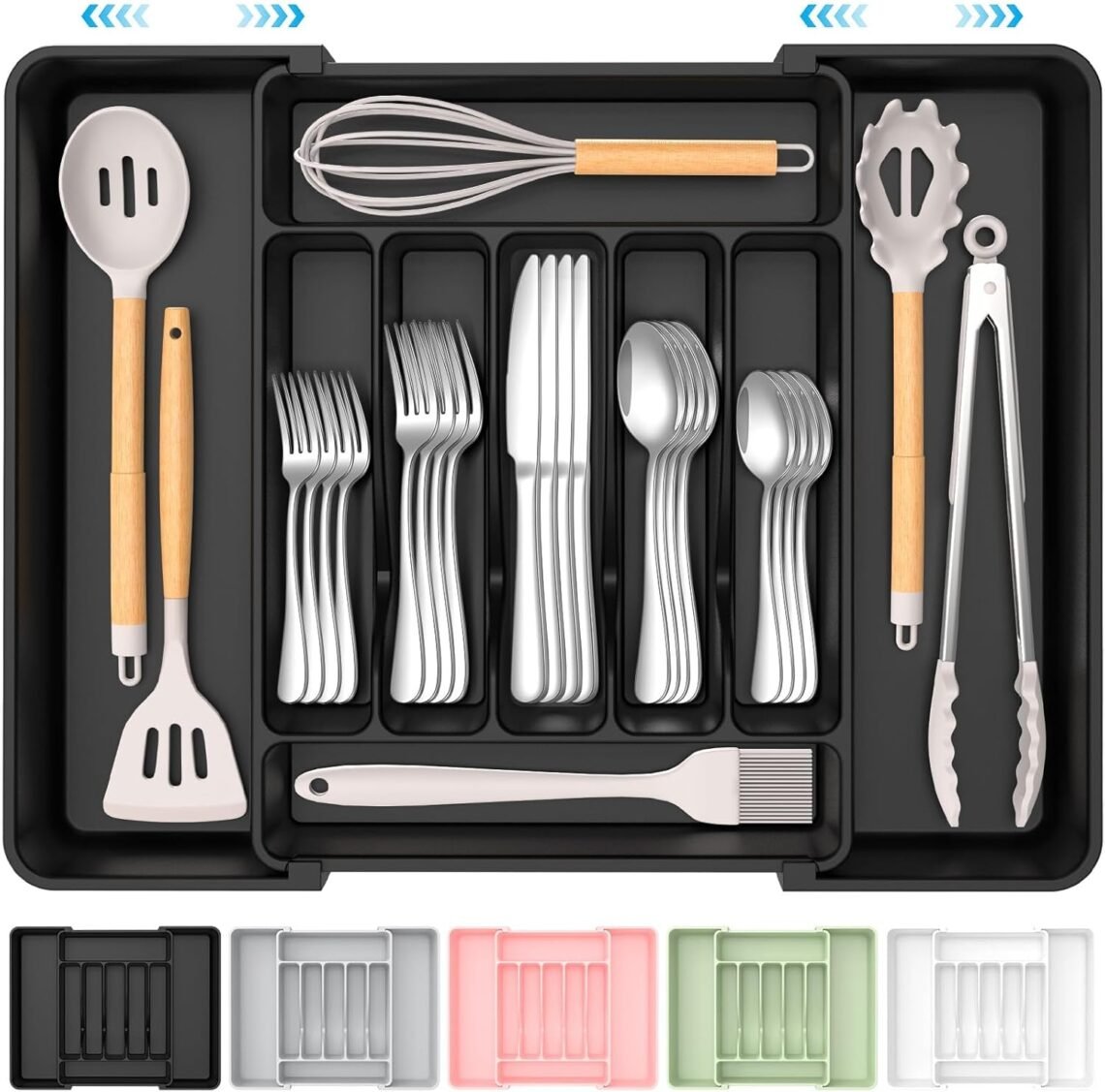
Ukeetap Expandable Silverware Organizer: Adjustable Drawer Storage Analysis


Executive Summary
The Ukeetap Expandable Silverware Organizer provides adjustable drawer storage through width expansion from 31.5cm to 53.3cm (12.4″ to 21″) accommodating varying drawer dimensions whilst offering 7-9 compartments depending on expansion configuration. The system employs BPA-free plastic construction with unique buckle mechanism enabling smooth sliding adjustment without assembly requirements, addressing common challenges of fixed-size organisers incompatible with non-standard drawer dimensions. This analysis examines expansion mechanism functionality, compartment configuration variations, material food-safety certifications, dimensional compatibility with UK drawer standards, buckle design durability, and multi-purpose applications beyond cutlery storage.
Contents
Product Overview & Expandable Design Concept
Understanding the expandable design philosophy clarifies how this organiser addresses limitations of fixed-size drawer inserts.
Expandable Design Rationale
Fixed-Size Organiser Problem: Traditional cutlery trays feature predetermined dimensions creating compatibility challenges:
- Too narrow: Wasted drawer space on sides creating unusable gaps
- Too wide: Won’t fit drawer at all, requiring return/exchange
- Precise fit required: Necessitates careful measurement and limited product selection
- Non-standard drawers: Older homes, custom cabinetry, or international furniture often feature unusual dimensions incompatible with standard organisers
Expandable Solution: Variable width accommodation enables single product to fit wide range of drawer sizes eliminating precise measurement requirements and expanding compatibility.
Product Positioning
Brand Context: Ukeetap specialises in adjustable storage solutions emphasising flexibility and multi-purpose functionality across kitchen, bathroom, and general household organisation categories.
Target Market:
- Households with non-standard drawer dimensions
- Renters unable to modify built-in cabinetry requiring adaptable solutions
- Users seeking single organiser compatible with multiple drawers throughout home
- Gift-givers requiring “universal fit” products suitable for unknown drawer dimensions
- Organisational enthusiasts wanting uniform aesthetic across varying drawer sizes
Core Features Summary
Capacity: 7-9 compartments depending on expansion state
Adjustability: Width expands from 12.4″ to 21″ (31.5cm to 53.3cm)
Material: BPA-free plastic ensuring food-contact safety
Installation: No assembly required – unfold and use
Mechanism: Unique buckle design enabling smooth adjustment
Applications: Kitchen utensils, cosmetics, jewellery, stationery, multi-purpose storage
Expansion Mechanism & Adjustment System
The expansion system represents the product’s primary differentiating feature requiring detailed examination of functionality and reliability.
Two-Panel Expansion Design
Configuration: Product description specifies “2 expandable panels” suggesting three-section construction:
- Central Fixed Section: Core compartments maintaining consistent position
- Left Expandable Panel: Slides outward increasing overall width
- Right Expandable Panel: Slides outward in opposite direction
Bilateral Expansion: Two-sided expansion creates balanced width increase maintaining central positioning within drawer rather than asymmetric extension favouring one side.
Expansion Range
Minimum Width: 12.4 inches (31.5cm) when fully contracted
Maximum Width: 21 inches (53.3cm) when fully extended
Expansion Range: 8.6 inches (21.8cm) total adjustment capability
Range Significance:
- Accommodates narrow drawers typical in compact kitchens (30-35cm)
- Extends to fit generous drawers in luxury kitchens (50-55cm)
- Covers approximately 70% of standard drawer width ranges encountered in UK homes
Adjustment Mechanism
Buckle System: “Unique buckle design allows smooth sliding and convenient adjustment” according to product specifications.
Operation Principles:
- Locking Position: Buckles engage securing panels at desired width preventing unwanted contraction during use
- Release: User activates buckle release mechanism (likely press-button or lever)
- Sliding: Panels slide freely along tracks whilst buckles disengaged
- Positioning: User adjusts to desired width matching drawer dimensions
- Locking: Buckles re-engage automatically or manually securing panels in position
Smooth Operation: “Smooth sliding” claim suggests low-friction track design enabling easy adjustment without excessive force or binding.
Expansion Increments
Continuous vs Stepped Adjustment:
- Continuous: Panels slide to any position within range allowing precise drawer fitting
- Stepped: Predetermined positions (every 1-2cm) where buckles lock, limiting precision but improving stability
Product documentation doesn’t specify which system employed. Visual examination of product imagery may reveal track design indicating mechanism type.
Stability Considerations
Lateral Rigidity: Expanded organiser must resist:
- Collapsing inward when items removed or added
- Spreading outward under internal item weight
- Twisting or racking when drawer opened/closed
- Shifting during normal drawer use cycles
Buckle Loading: Buckle mechanisms bear stress maintaining panel positions – quality and quantity of buckles determines long-term stability and resistance to loosening over repeated use cycles.
Dimensions & Drawer Compatibility
Understanding complete dimensional specifications clarifies compatibility with UK standard and custom drawer configurations.
Complete Dimensional Specifications
Width (Adjustable):
- Minimum: 31.5cm (12.4″)
- Maximum: 53.3cm (21″)
- Range: 21.8cm adjustment capability
Depth: Not specified in available documentation – critical dimension requiring verification before purchase
Height: Described as “deep compartments” but specific measurement not provided
Measurement Advisory: Manufacturer recommends “Measure your drawer before buying for the best fit” acknowledging importance of depth and height compatibility beyond adjustable width dimension.
UK Standard Drawer Dimensions
Typical Kitchen Drawer Widths:
- Narrow drawers (cutlery): 30-40cm internal width
- Standard drawers (utensils): 40-50cm internal width
- Wide drawers (pots/pans): 50-80cm internal width
Organiser Compatibility:
- Narrow Drawers (30-40cm): Excellent fit – minimum 31.5cm accommodates narrow end, expansion to 40cm perfectly fills standard cutlery drawer
- Standard Drawers (40-50cm): Good fit – expansion range covers most of this category up to 53.3cm
- Wide Drawers (50-80cm): Partial fit – accommodates up to 53.3cm leaving gaps in drawers exceeding maximum expansion
Depth Compatibility Considerations
Standard Drawer Depths:
- Shallow drawers: 30-35cm depth
- Standard drawers: 40-50cm depth
- Deep drawers: 50-60cm depth
Organiser Depth: Without specified depth dimension, users must verify product depth matches drawer internal depth allowing:
- Sufficient depth for organiser to fit without preventing drawer closure
- Minimal wasted space at drawer back reducing efficiency
- Adequate depth for intended items (long serving spoons require deeper organisers than standard cutlery)
Height Compatibility
Drawer Internal Height: Kitchen drawers typically provide 6-12cm internal height
“Deep Compartments” Claim: Suggests organiser features substantial compartment depth suitable for:
- Standard cutlery (forks, knives, spoons): 3-5cm height adequate
- Serving utensils (ladles, serving spoons): 5-8cm height preferred
- Kitchen tools (peelers, can openers): Variable height requirements
Drawer Closure: Organiser height must not exceed drawer internal height preventing drawer from closing fully or creating binding against drawer above.
Measurement Recommendations
Pre-Purchase Measurements:
- Width: Measure drawer internal width at narrowest point (some drawers taper) – organiser minimum (31.5cm) must fit narrowest point; maximum (53.3cm) should approach drawer width for optimal space utilisation
- Depth: Measure from drawer front to back at drawer bottom – verify organiser depth (obtain from seller if not specified) fits without preventing drawer closure
- Height: Measure internal height from drawer bottom to underside of drawer above or countertop – ensure organiser height allows drawer closure with adequate clearance
- Obstructions: Note any drawer slides, supports, or internal features reducing usable space
7-9 Compartment Configuration Analysis
The variable compartment count from 7 to 9 sections reflects changing configuration as organiser expands.
Compartment Count Variation
Specification: “7-9 compartments with 2 expandable panels maximize drawer space”
Configuration Interpretation:
Contracted State (Minimum Width 31.5cm): 7 Compartments
- Central fixed section: 5 core compartments (typical cutlery arrangement – knives, forks, spoons, teaspoons, serving utensils)
- Expandable panels: 1 compartment each when fully contracted
- Total: 5 + 1 + 1 = 7 compartments
Expanded State (Maximum Width 53.3cm): 9 Compartments
- Central fixed section: 5 core compartments (unchanged)
- Expandable panels: 2 compartments each when fully extended (expansion reveals or creates additional compartment divisions)
- Total: 5 + 2 + 2 = 9 compartments
Partial Expansion: 7-9 Compartments
- Intermediate positions create 8 compartments depending on expansion degree
- Compartment visibility/accessibility changes as panels extend
Compartment Size Variations
Fixed Compartments: Central section compartments maintain consistent dimensions regardless of expansion state
Expandable Compartments: Panel compartments change size as organiser expands:
- Contracted: Narrower compartments suitable for small items
- Expanded: Wider compartments accommodating larger utensils or greater quantities
Typical Compartment Layout
Standard Cutlery Organisation:
- Compartment 1: Dinner knives
- Compartment 2: Dinner forks
- Compartment 3: Dinner spoons
- Compartment 4: Teaspoons
- Compartment 5: Dessert forks/spoons or serving utensils
- Compartments 6-7 (Expandable): Specialty items, steak knives, chopsticks, or overflow
- Compartments 8-9 (Fully Expanded): Additional serving utensils, kitchen tools, or organisational accessories
Compartment Depth
“Deep Compartments” Feature: Described as “suitable for storing various tableware, enabling quick access”
Depth Advantages:
- Prevents cutlery from overlapping or stacking reducing retrieval ease
- Accommodates longer serving spoons, ladles, or specialty utensils
- Allows stacking of identical items (multiple forks) without exceeding compartment height
- Reduces likelihood of items catching on drawer sides during opening/closing
Typical Compartment Depths:
- Shallow trays: 3-4cm (adequate for standard cutlery only)
- Standard trays: 5-6cm (comfortable for most flatware)
- Deep trays: 7-10cm (accommodates serving utensils and kitchen tools)
Product’s “deep compartments” claim suggests 6-10cm depth range though specific measurement requires verification.
BPA-Free Plastic Material & Food Safety
Material selection affects food safety, durability, and environmental considerations for items storing food-contact utensils.
BPA-Free Certification
Primary Claim: “Made of premium BPA-free plastic, the flatware organizer is food-safe, durable and waterproof”
BPA Context:
- Bisphenol A (BPA): Industrial chemical used in some plastics and resins
- Health Concerns: Potential endocrine disruption leading to consumer preference for BPA-free products
- Food-Contact Relevance: Cutlery organisers store items directly contacting food, making BPA-free status important for health-conscious consumers
- Regulatory Status: BPA restricted in certain applications (baby bottles) in UK/EU; consumer demand drives BPA-free offerings in other categories
BPA-Free Verification: Claim represents manufacturer assertion; consumers seeking additional assurance may request certification documentation or third-party testing results.
Plastic Type Speculation
Product doesn’t specify exact plastic type. Common BPA-free plastics for kitchen organisers include:
Polypropylene (PP – Recycling Code 5):
- Most common choice for BPA-free kitchen organisers
- Naturally BPA-free (doesn’t require BPA in manufacturing)
- Durable, dishwasher-safe, chemical-resistant
- Food-grade variants approved for food contact
- Moderate rigidity suitable for structural organisers
Polyethylene (PE – Recycling Codes 2 & 4):
- Also naturally BPA-free
- Softer and more flexible than PP
- Excellent chemical resistance
- Less common for rigid organisers due to flexibility
ABS Plastic:
- Can be formulated BPA-free
- Very rigid and durable
- Good dimensional stability
- Higher cost than PP/PE
Polypropylene most likely given “durable” claim and kitchen organiser category standards.
Food-Safe Designation
“Food-Safe” Claim: Indicates material appropriate for contact with food or food-contact items (cutlery)
Food-Safe Requirements:
- No migration of harmful substances into food
- Resistant to degradation from food acids, oils, or alcohol
- Stable across typical storage temperatures
- Non-toxic if inadvertent mouth contact occurs
- Compliant with food-contact regulations (EU Regulation 10/2011, UK equivalents)
Practical Implications: Users can safely store clean cutlery in organiser without concern about chemical contamination or material degradation affecting utensils subsequently contacting food.
Durability Characteristics
“Durable” Claim: Suggests material resists:
- Cracking or breaking from impacts (dropped utensils, drawer slamming)
- Warping from weight of stored items
- Degradation from repeated cleaning cycles
- Stress fractures at buckle points or expansion joints
- Discolouration or fading over time
Expected Lifespan: Quality plastic drawer organisers typically provide 5-10+ years service with normal use and care.
Waterproof Properties
“Waterproof” Feature: Non-porous plastic construction prevents:
- Water absorption causing warping or swelling
- Mould or mildew growth in material
- Staining from coloured liquids
- Bacterial colonisation in porous structure
Cleaning Advantage: Waterproof material enables:
- Washing entire organiser under running water
- Dishwasher cleaning (if heat-resistant)
- Wiping with damp cloth removing crumbs or residue
- No drying time concerns before returning to drawer
Unique Buckle Design & Durability
The buckle mechanism represents critical functional component determining adjustment ease and long-term reliability.
Buckle Function
Primary Roles:
- Panel Securing: Lock expandable panels at desired width preventing unwanted movement
- Smooth Adjustment: Enable easy panel sliding when released for repositioning
- Stability Maintenance: Resist forces from drawer opening/closing and item removal/addition
“Unique Buckle Design”: Manufacturer emphasises proprietary design differentiating product from competitors, suggesting engineering investment in mechanism reliability and ease-of-use.
Buckle Operation
Likely Mechanism Types:
Push-Button Release:
- User presses button releasing buckle teeth from track
- Panels slide freely whilst button depressed
- Release button allows automatic re-engagement
- Advantage: One-handed operation possible
Lever/Flip Lock:
- Lever flipped to disengage buckle
- Panel slides to position
- Lever flipped back engaging lock
- Advantage: Positive engagement feedback
Slide Lock:
- Lock slider moved to release position
- Panel adjusts whilst lock disengaged
- Slider returned to locked position
- Advantage: Visual indication of locked/unlocked state
Specific mechanism type not detailed in available product documentation; user reviews or detailed product videos would clarify exact design.
“Smooth Sliding” Performance
Low-Friction Design: “Smooth sliding” claim suggests:
- Polished track surfaces reducing friction
- Precision moulding creating proper clearances between sliding components
- Possible lubricant or surface treatment reducing drag
- Minimal binding or catching during adjustment
User Experience Implications:
- Easy initial installation – panels slide to drawer width without excessive force
- Simple readjustment if moving organiser to different drawer
- No frustration from stuck or binding mechanisms
- Suitable for users with limited hand strength
Durability Concerns
High-Stress Points:
- Buckle engagement teeth (wear from repeated locking/unlocking)
- Track surfaces (wear from panel sliding)
- Release button or lever (mechanical fatigue from repeated actuation)
- Panel connection points (stress from lateral forces)
Potential Failure Modes:
- Buckle teeth wearing reducing holding force – panels slip under load
- Release mechanism breaking preventing panel adjustment
- Track damage causing binding or rough sliding
- Plastic fatigue cracks at stress concentration points
Quality Indicators:
- Thick plastic construction at buckle points resisting flexing
- Multiple buckles distributing load rather than single-point attachment
- Reinforced areas around mechanical components
- Smooth operation out-of-box indicating precision manufacturing
Maintenance Considerations
Track Cleaning: Periodically wipe sliding tracks removing:
- Dust or crumbs potentially causing binding
- Sticky residue from spills affecting sliding smoothness
- Debris interfering with buckle engagement
Buckle Inspection: Examine buckle mechanisms for:
- Wear on engagement teeth
- Cracks in release buttons or levers
- Loosening of buckle mounting to panels
- Changes in operation smoothness indicating developing problems
Gentle Operation: Avoid forcing panels if resistance encountered – investigate cause rather than applying excessive force potentially damaging mechanism.
Deep Compartment Capacity & Item Storage
Compartment depth determines which items fit comfortably and how many of each type can be stored effectively.
Deep Compartment Advantages
Specification: “Deep compartments are suitable for storing various tableware, enabling quick access”
Depth Benefits:
1. Prevents Overlapping:
- Shallow compartments force cutlery to stack or overlap
- Deep compartments allow single-layer placement
- Easy retrieval without untangling or moving other pieces
- Reduced scratching from metal-on-metal contact
2. Accommodates Long Items:
- Serving spoons (25-30cm length) fit without protruding
- Ladles (28-35cm) store completely within compartment
- Long-handled serving forks or pasta servers
- Specialty utensils (iced tea spoons, bar spoons)
3. Increases Capacity:
- Greater depth allows vertical stacking of identical items
- Store complete cutlery set for 6-12 people in single organiser
- Reduces need for multiple storage locations
4. Versatility:
- Deep compartments suitable for cutlery plus kitchen tools
- Accommodates can openers, peelers, zesters, measuring spoons
- Enables multi-purpose storage beyond just flatware
Storage Capacity Estimates
Typical Compartment Contents:
Standard Cutlery Compartment (assuming 4-5cm width, 6-8cm depth):
- Dinner forks: 8-12 pieces
- Dinner knives: 8-12 pieces
- Dinner spoons: 8-12 pieces
- Teaspoons: 12-16 pieces (smaller, more fit)
- Serving utensils: 4-6 pieces per compartment
Total System Capacity (7-9 compartments):
- Complete flatware service for 8-12 people
- Plus serving utensils, specialty items, and kitchen tools
- Approximately 70-100 total pieces depending on item types and sizes
“Quick Access” Design
Accessibility Features:
- Open-Top Design: No lids or covers impeding immediate access
- Clear Compartment Divisions: Easy visual identification of item locations
- Adequate Depth: Items don’t protrude above compartment edges catching on drawer above
- Smooth Interior: No rough edges or textures snagging cutlery during removal
Workflow Benefits:
- Open drawer and immediately see/access needed items
- No digging through jumbled piles
- One-handed retrieval possible
- Replacement equally quick – drop item in appropriate compartment
No-Assembly Installation Process
Understanding the setup procedure clarifies ease-of-use and time investment required before functional storage achieved.
No-Assembly Feature
Primary Claim: “No assembly needed – just unfold and start organizing your kitchen utensil”
“Unfold” Terminology: Suggests organiser ships in compact folded state for packaging efficiency, requiring simple unfolding to operational configuration.
Assembly-Free Advantages:
- No instruction manual interpretation required
- No small parts to lose or install incorrectly
- No tools needed (screwdrivers, allen keys)
- Immediate use within seconds of unboxing
- Suitable for users uncomfortable with assembly tasks
- Gift-ready – recipient can use immediately
Installation Steps
Simplified Process:
- Unbox: Remove organiser from packaging, discard packing materials
- Unfold: Extend organiser from shipping configuration to functional form (panels may be folded inward for compact packaging)
- Measure Drawer: Verify drawer dimensions if not previously measured
- Adjust Width: Release buckles, slide panels to appropriate width matching drawer dimensions
- Lock Buckles: Secure buckles at desired width
- Place in Drawer: Lower organiser into drawer verifying fit
- Fine-Tune: Adjust width if necessary achieving optimal drawer fit
- Load Cutlery: Begin organising utensils in compartments
Time Investment: Entire process typically requires 2-5 minutes from unboxing to loaded organiser ready for use.
First-Use Considerations
Plastic Odour: New plastic products sometimes emit manufacturing odours:
- Typically dissipates within 24-48 hours exposure to air
- Accelerate by washing organiser before use
- Normal occurrence not indicating quality issues
Initial Cleaning: Recommended before food-contact use:
- Wipe with damp cloth removing manufacturing residue or packaging dust
- Rinse under running water if desired
- Dry before placement in drawer
- Not strictly necessary but advisable for hygiene
Fit Verification
Drawer Compatibility Check:
- Width: Organiser should extend nearly full drawer width with minimal gaps (1-2cm maximum on each side acceptable)
- Depth: Organiser depth should allow drawer to close fully without binding
- Height: Adequate clearance between loaded organiser and drawer above/countertop
- Movement: Organiser should remain stationary when drawer opened/closed (friction with drawer bottom prevents sliding)
Adjustment if Needed: If initial fit suboptimal:
- Readjust width expanding or contracting as needed
- Verify buckles fully engaged preventing unwanted movement
- Confirm panels extended symmetrically for balanced appearance
Cutlery Organization & Kitchen Applications
Primary use case involves flatware storage and kitchen utensil organisation.
Standard Cutlery Organization
Typical Layout Strategy:
Core Compartments (5 central divisions):
- Compartment 1: Dinner knives (table knives, steak knives)
- Compartment 2: Dinner forks (standard table forks)
- Compartment 3: Dinner spoons (tablespoons, soup spoons)
- Compartment 4: Dessert forks and spoons (smaller than dinner size)
- Compartment 5: Teaspoons and coffee spoons
Expandable Compartments (2-4 additional divisions):
- Serving Utensils: Serving spoons, serving forks, slotted spoons
- Specialty Flatware: Seafood forks, butter knives, grapefruit spoons
- Kitchen Tools: Can opener, bottle opener, corkscrew, peeler
- Measuring Tools: Measuring spoons, small measuring cups
Alternative Organization Schemes
By Frequency of Use:
- Front compartments: Daily-use items (dinner forks, spoons, knives, teaspoons)
- Rear compartments: Occasional-use items (serving utensils, specialty tools)
- Advantage: Most-accessed items in most convenient location
By Meal Course:
- Left section: Breakfast items (teaspoons, dessert forks for fruit)
- Centre section: Lunch/dinner items (full-size cutlery)
- Right section: Entertaining items (serving pieces, specialty forks)
- Advantage: Logical grouping matching meal preparation workflows
By Family Member:
- Separate compartments for each household member’s personal cutlery
- Useful for hygiene-conscious households or varying preferences
- Children’s compartments separate from adult cutlery
Kitchen Tool Storage
Beyond Cutlery Applications:
Small Kitchen Gadgets:
- Vegetable peeler, garlic press, lemon zester
- Apple corer, melon baller, egg slicer
- Pizza cutter, pastry wheel, biscuit cutters
- Thermometers, timers, bag clips
Measuring Implements:
- Measuring spoon sets
- Small measuring cups (1/4 cup, 1/3 cup)
- Kitchen scales accessories
Bar Tools:
- Cocktail strainers, muddlers, bar spoons
- Bottle openers, wine keys, pour spouts
- Cocktail picks, stirrers
Organization Best Practices
Grouping Logic:
- Group similar items together (all forks in one compartment)
- Separate sharp from non-sharp items reducing injury risk during retrieval
- Position heavy items in bottom of compartments for stability
- Reserve wider compartments (from expansion) for bulkier items
Capacity Management:
- Don’t overfill compartments – items should lie relatively flat
- Leave slight clearance at top preventing items catching on drawer above
- Rotate stock if storing backup cutlery – use older items first
Multi-Purpose Applications Beyond Kitchen
The expandable design and compartmentalised structure suit diverse organisational needs across household spaces.
Bathroom Applications
Cosmetics Storage:
- Makeup brushes (sorted by type – foundation, powder, eye)
- Lip products (lipsticks, glosses, liners in separate compartments)
- Eye products (mascaras, eyeliners, eyeshadows)
- Nail care items (files, buffers, cuticle tools, polishes)
- Hair accessories (clips, bobby pins, elastic bands)
Toiletries Organization:
- Razors and blades (separate compartment for safety)
- Dental care items (toothbrushes, floss, interdental brushes)
- Grooming tools (tweezers, nail clippers, scissors)
- Travel-size products (samples, trial sizes)
Advantages for Bathroom:
- Waterproof plastic resists moisture and humidity
- Easy cleaning if cosmetic spills occur
- Expandable width fits varying vanity drawer sizes
- Deep compartments prevent items tipping or mixing
Jewellery Storage
Compartmentalized Jewellery:
- Rings (sorted by style, material, or frequency of wear)
- Earrings (pairs kept together in individual compartments)
- Bracelets (coiled or laid flat)
- Necklaces (shorter lengths that don’t tangle)
- Watches (if compartments deep enough for watch face)
- Brooches, cufflinks, tie clips
Protection Benefits:
- Separate compartments prevent scratching between items
- Deep sections reduce tangling of chains or delicate pieces
- Plastic cushioning less harsh than direct drawer contact
- Visual organisation enables quick piece selection
Limitations:
- Not suitable for expensive jewellery requiring plush lining
- Lacks traditional jewellery box aesthetic/security features
- Better for costume jewellery or everyday pieces
Office & Stationery Storage
Desk Drawer Organisation:
- Pens and pencils (sorted by type or colour)
- Markers and highlighters
- Erasers, sharpeners, correction fluid
- Paper clips, binder clips (various sizes in separate compartments)
- Rubber bands, thumb tacks
- USB drives, memory cards
- Sticky notes, index cards
Craft Supplies:
- Scissors, craft knives, cutting tools
- Adhesives (glue sticks, tape rolls)
- Small paintbrushes or applicators
- Embellishments (buttons, sequins, beads in separate sections)
- Threads, needles, pins
Bedroom Applications
Accessories Storage:
- Belts (coiled in compartments)
- Ties (folded or rolled)
- Socks (pairs kept together, sorted by colour/style)
- Undergarments (separated by type)
- Scarves (lightweight ones folded)
Small Personal Items:
- Watches and watch bands
- Sunglasses cases
- Wallets and cardholders
- Keys and keychains
- Coins (sorted by denomination)
Workshop & Garage Storage
Small Hardware:
- Screws (sorted by size and type)
- Nails, tacks, staples
- Nuts, bolts, washers
- Drill bits (if compartments deep enough)
- Allen keys, hex wrenches
Craft/Hobby Tools:
- Model-making tools
- Jewelry-making components
- Fishing tackle (hooks, lures, weights)
- Sewing notions (threads, bobbins, needles)
Gift-Giving Applications
“Perfect Gift” Positioning: Manufacturer markets product as “perfect gift for housewarming parties or new home moves”
Gift-Worthiness Factors:
- Universal Utility: Everyone needs drawer organisation
- Adjustable Fit: Works in recipient’s drawers regardless of size (within expansion range)
- Immediate Usability: No assembly allows recipient to use upon unwrapping
- Practical Value: Addresses real organisational need
- Modest Price Point: Appropriate for casual gift-giving occasions
- Versatility: Suitable for kitchen, bathroom, office, bedroom use
Ideal Gift Recipients:
- New homeowners/renters setting up first independent residence
- Recently married couples combining households
- College students in dormitories or first flats
- Anyone reorganising or renovating living spaces
- Minimalists/organisation enthusiasts
Cleaning & Maintenance Requirements
Understanding care requirements ensures longevity and hygiene of organisational system storing food-contact items.
Routine Cleaning
Frequency: Clean organiser when:
- Crumbs, dust, or debris visible in compartments
- Spills occur (food, liquids)
- Monthly or quarterly as part of drawer deep-cleaning routine
- Seasonally when rotating stored items
Basic Cleaning Method:
- Empty: Remove all items from organiser
- Shake: Turn organiser upside-down over bin removing loose crumbs or debris
- Wipe: Use damp cloth with mild washing-up liquid wiping all surfaces
- Detail: Use small brush or cotton swab cleaning corners and crevices
- Rinse: Rinse under running water if heavily soiled
- Dry: Towel-dry or air-dry completely before returning items
- Replace: Return items to appropriate compartments
Time Investment: 5-10 minutes for thorough cleaning
Dishwasher Compatibility
Material Considerations: BPA-free plastic typically dishwasher-safe, though product documentation doesn’t explicitly confirm dishwasher compatibility
If Dishwasher-Safe:
- Place on top rack away from heating element
- Secure expandable panels preventing shifting during wash cycle
- Use gentle cycle avoiding excessive heat
- Allow complete cooling before handling
- Inspect buckle mechanisms after washing verifying proper function
Hand-Washing Recommended:
- Protects buckle mechanisms from dishwasher water pressure
- Prevents potential warping from dishwasher heat
- Extends product lifespan through gentler cleaning
- Ensures proper drying of mechanical components
Deep Cleaning
Intensive Cleaning (2-4 times yearly):
- Remove organiser from drawer completely
- Wash in sink with warm soapy water and soft brush
- Clean drawer interior whilst organiser removed
- Rinse organiser thoroughly removing all soap residue
- Dry completely (overnight air-drying ideal)
- Inspect for damage, cracks, or wear
- Clean buckle tracks removing accumulated debris
- Return to clean drawer
Maintenance Tasks
Buckle System:
- Periodically test smooth operation – should slide easily when released
- Clean tracks if sliding becomes sticky or difficult
- Inspect engagement teeth for wear or damage
- Verify secure locking at various widths
Structural Inspection:
- Check for cracks, particularly at stress points (buckles, corners)
- Verify compartment dividers remain secure
- Ensure expansion panels move symmetrically
- Look for warping or deformation from overloading
Replacement Indicators:
- Buckles no longer hold panels securely
- Cracks developing in plastic structure
- Compartments broken or dividers detaching
- Warping preventing flat drawer placement
- Staining or discolouration not removable through cleaning
Complete Technical Specifications
Complete Product Specifications
| Specification Category | Details |
|---|---|
| Brand | Ukeetap |
| Product Type | Expandable silverware/cutlery drawer organizer |
| Compartments | 7-9 compartments (varies with expansion state) |
| Expansion Panels | 2 expandable panels (bilateral expansion) |
| Width – Minimum | 31.5cm (12.4 inches) fully contracted |
| Width – Maximum | 53.3cm (21 inches) fully extended |
| Width – Adjustment Range | 21.8cm (8.6 inches) total expansion capability |
| Depth | Not specified – verify with seller before purchase |
| Height | Deep compartments – specific measurement not provided |
| Primary Material | Premium BPA-free plastic (likely polypropylene) |
| Food-Safe | Yes – suitable for food-contact utensil storage |
| BPA Status | BPA-free certified |
| Waterproof | Yes – non-porous plastic construction |
| Durability | Durable plastic resisting cracking and warping |
| Adjustment Mechanism | Unique buckle design with smooth sliding tracks |
| Assembly Required | No – unfold and use immediately |
| Dishwasher Safe | Not explicitly stated – hand washing recommended |
| Colour | Verify with seller (product images suggest grey/white options) |
| Primary Use | Kitchen cutlery and utensil organization |
| Alternative Uses | Cosmetics, jewellery, stationery, multi-purpose storage |
| Gift Suitable | Yes – ideal for housewarming, new homes, organisation gifts |
| Warranty | Verify with seller/manufacturer |
Drawer Compatibility Guide
| Drawer Width | Compatibility | Fit Quality | Notes |
|---|---|---|---|
| Under 31.5cm | Not Compatible | N/A | Narrower than minimum organiser width |
| 31.5-35cm | Compatible | Tight Fit | Minimal expansion required, maximal space utilisation |
| 35-45cm | Compatible | Excellent Fit | Mid-range expansion, optimal performance zone |
| 45-53cm | Compatible | Good Fit | Near-maximum expansion, still functional |
| 53-55cm | Marginal | Gaps on Sides | At maximum expansion leaving small gaps |
| Over 55cm | Not Ideal | Significant Gaps | Organiser too narrow, consider alternative product |
Essential Usage & Care Summary
Installation Best Practices
- Measure drawer width before purchase verifying 31.5-53.3cm compatibility
- Measure drawer depth and height ensuring adequate clearance
- Unfold organiser from packaging to operational configuration
- Release buckle mechanisms for panel adjustment
- Expand width matching drawer dimensions (leave 5-10mm clearance each side)
- Lock buckles securely at desired width
- Place in drawer verifying smooth drawer closure
- Load items testing compartment depths and capacities
Organization Strategies
- Group similar items together in dedicated compartments
- Position most-used items in most accessible compartments
- Use expandable compartments for larger or specialty items
- Don’t overfill – items should lie relatively flat
- Separate sharp items from general cutlery for safety
- Reserve deeper compartments for longer serving utensils
- Consider frequency-of-use or meal-type organization schemes
Cleaning & Maintenance
- Remove items periodically shaking out crumbs and debris
- Wipe with damp cloth and mild washing-up liquid monthly
- Deep clean 2-4 times yearly with full wash and drawer cleaning
- Hand wash recommended protecting buckle mechanisms
- Dry completely before returning items preventing moisture accumulation
- Inspect buckles and tracks for wear or debris accumulation
- Clean expansion tracks if sliding becomes difficult
- Check for cracks or damage replacing if structural integrity compromised
What to Avoid
- Don’t force buckle mechanisms – investigate if resistance encountered
- Avoid overloading compartments causing warping
- Don’t place in dishwasher unless manufacturer explicitly confirms compatibility
- Avoid harsh chemical cleaners potentially damaging plastic
- Don’t store wet items creating moisture accumulation and potential odours
- Avoid sharp-edged items potentially cutting plastic compartment walls
- Don’t use in drawers narrower than 31cm or wider than 55cm for optimal function
Analysis Summary
The Ukeetap Expandable Silverware Organizer addresses fundamental compatibility challenges inherent to fixed-size drawer inserts through 21.8cm width adjustment range spanning 31.5-53.3cm, accommodating approximately 70% of standard UK drawer dimensions without requiring precise pre-purchase measurements. The bilateral expansion design employing two adjustable panels maintains balanced positioning within drawers whilst transitioning compartment count from 7 to 9 sections as width increases, creating flexible storage adapting to both drawer dimensions and item quantities.
BPA-free plastic construction provides food-safe storage for cutlery and food-contact utensils whilst offering durability, waterproof properties, and easy cleaning through non-porous surface resisting moisture absorption, staining, and bacterial colonisation. The material choice balances safety concerns (BPA elimination), functional requirements (waterproofing, durability), and cost-effectiveness creating accessible organisational solution suitable for health-conscious consumers prioritising food-contact safety certifications.
The unique buckle mechanism represents critical functional component enabling smooth panel sliding during adjustment whilst securing panels at desired widths preventing unwanted movement during drawer operation cycles. The no-assembly unfold-and-use design eliminates setup complexity enabling immediate functionality within seconds of unboxing, supporting manufacturer positioning as gift-worthy item requiring no recipient effort or technical skill for implementation.
Deep compartment construction accommodates diverse items from standard cutlery through long serving utensils and kitchen tools, preventing overlapping that complicates retrieval whilst maximising capacity through vertical space utilisation. The 7-9 compartment range provides sufficient organisation for complete flatware service for 8-12 people plus serving pieces and specialty items, addressing typical household cutlery storage requirements within single drawer allocation.
Multi-purpose versatility extends utility beyond kitchen applications encompassing bathroom cosmetics storage, bedroom accessories organisation, office stationery management, and workshop hardware separation. This adaptability increases product value enabling users to deploy across multiple household locations or repurpose as needs evolve, justifying investment through extended utility beyond singular cutlery storage function.
The expandable design particularly benefits renters, frequent movers, or households with non-standard drawer dimensions where fixed-size organisers prove incompatible or waste significant drawer space through poor dimensional matching. The adjustment capability creates “universal fit” characteristics attractive to gift-givers uncertain of recipient drawer specifications and users unwilling to undertake precise measurement before purchase.
Limitations include lack of specific depth and height dimensions in product documentation requiring clarification with sellers before purchase, potential buckle mechanism wear over extended use cycles as mechanical components experience repeated stress, and compatibility constraints for drawers narrower than 31cm or substantially wider than 55cm where organiser cannot adequately fill space. The plastic construction, whilst durable, lacks premium aesthetic of wooden or bamboo alternatives appealing to users prioritising visual appearance over functional flexibility.
The system suits households requiring drawer organisation with varying dimensions, renters unable to modify built-in cabinetry, users seeking multi-purpose storage solutions deployable across rooms, gift-givers needing universally-compatible presents, and organisation enthusiasts wanting uniform systems across diverse drawer sizes. The straightforward unfold-and-use installation appeals particularly to users uncomfortable with assembly tasks or desiring immediate functionality.
Practical value derives from space maximisation through compartmentalised storage preventing jumbled item mixing, time savings through quick-access organisation enabling immediate item identification and retrieval, and protection of drawer interiors from scratches or staining through intermediary plastic layer. The moderate price point typical of expandable drawer organisers (£15-30 range) creates accessible entry point for household organisation improvements without substantial investment.
Verification of depth and height specifications represents essential pre-purchase step preventing disappointment from incompatible drawer dimensions, as width adjustment alone cannot compensate for inadequate depth or height clearances. Users should request complete dimensional specifications from sellers or examine detailed product descriptions ensuring compatibility across all three dimensional axes before ordering.
Product Availability
The Ukeetap Expandable Silverware Organizer is available through various retailers including Amazon in multiple colour options. Product specifications, exact dimensions (particularly depth and height), and buckle mechanism details may vary by seller. Verify complete dimensional specifications with seller before purchase ensuring compatibility with your specific drawer dimensions.
As an Amazon Associate I earn from qualifying purchases.
Product specifications and availability subject to change. Verify current details including exact depth and height measurements, buckle mechanism design, colour options, and warranty terms with retailer before purchase. Measure your drawer’s width, depth, and height before ordering to ensure optimal compatibility within the 31.5-53.3cm width range.

6 Comments on “expandable silverware organizer”
Comments are closed.