33-Piece Kitchen Utensil Set: Comprehensive Product Examination


Executive Summary
This 33-piece kitchen utensil collection represents a comprehensive toolset combining stainless steel handle construction with silicone functional heads. The set encompasses cooking implements, measuring instruments, food preparation gadgets, and storage solutions designed to address multiple kitchen tasks within a single purchase. This analysis examines material composition, individual component specifications, construction methodology, and practical application scenarios for this extensive utensil assembly.
Contents
Complete Set Composition & Inventory
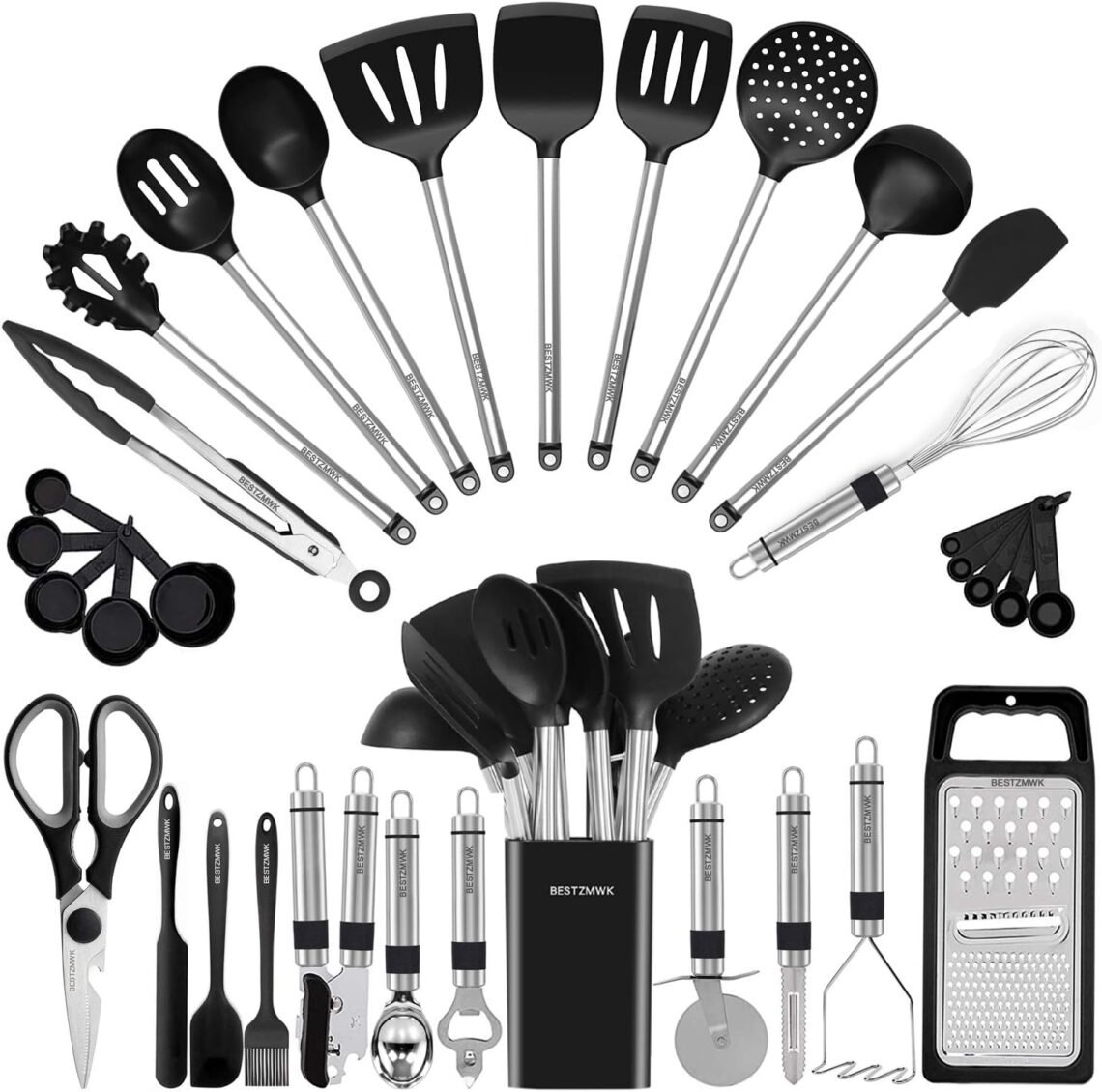
The 33-piece designation encompasses individual utensils, measuring implements, specialty gadgets, and the storage container. Understanding the complete inventory assists in determining set comprehensiveness for specific kitchen requirements.
Core Cooking Utensils
The primary cooking implement category includes:
- Turner (Spatula): Flat broad surface for flipping and lifting foods
- Slotted Turner: Perforated version allowing liquid drainage during lifting
- Skimmer: Wide perforated head for removing foods from liquids
- Serving Spoon: Deep bowl configuration for scooping and serving
- Ladle: Deep bowl with pouring lip for liquid transfer
- Pasta Server: Pronged design with central opening for pasta portion control
- Kitchen Tongs: Scissor-action gripping tool for handling hot foods
- Whisk: Wire loop configuration for mixing and aerating
- Spatula Spreader: Narrow flexible blade for spreading applications
- Spoon Spatula: Hybrid design combining spoon bowl with scraping edge
Measuring Instruments
Precision measurement tools included:
- Large Measuring Spoons: Set typically including tablespoon measurements
- Small Measuring Spoons: Set typically including teaspoon measurements
Specialty Kitchen Gadgets
Additional functional implements comprise:
- Basting Brush: Silicone bristles for applying liquids to food surfaces
- Flexible Spatula: Thin blade for cake decorating and spreading
- Multi-Surface Grater: Metal grating surface for cheese, vegetables, citrus zest
- Fine Mesh Strainer: For sifting, draining, or straining operations
- Kitchen Scissors: Multi-purpose cutting tool with stainless steel blades
- Potato Masher: Perforated pressing surface for vegetable mashing
- Manual Can Opener: Rotating blade mechanism for tin opening
- Bottle Opener: Leverage-based cap removal tool
- Pizza Cutter: Rotating wheel blade for cutting baked goods
- Ice Cream Scoop: Curved bowl for portioning frozen desserts
Storage Solution
- Utensil Holder: Cylindrical container for countertop storage organisation
Complete Inventory Breakdown
| Category | Items Included | Quantity |
|---|---|---|
| Primary Cooking Utensils | Turner, Slotted Turner, Skimmer, Spoon, Ladle, Pasta Server, Tongs, Whisk, Spatula Spreader, Spoon Spatula | 10 pieces |
| Measuring Tools | Large Measuring Spoons (set), Small Measuring Spoons (set) | Variable (typically 8-10 individual spoons) |
| Specialty Gadgets | Brush, Spatula, Grater, Strainer, Scissors, Potato Masher, Can Opener, Bottle Opener, Pizza Cutter, Ice Cream Scoop | 10 pieces |
| Storage | Holder/Container | 1 piece |
| Total Set | All Components | 33 pieces |
Material Construction Analysis
The set employs a dual-material construction methodology combining metallic handles with polymeric functional heads. This hybrid approach attempts to balance structural integrity, heat resistance, and non-stick cookware compatibility.
Construction Philosophy
The design separates handle and working head materials to optimise each component for its specific function. Stainless steel handles provide rigidity and durability for the gripping portion, whilst silicone heads offer flexibility and non-scratch properties where utensils contact cookware and food.
This construction differs from single-material approaches such as all-silicone utensils (which may lack structural rigidity) or all-metal implements (which can scratch non-stick surfaces and conduct heat to handles).
Assembly Methodology
The connection between stainless steel handles and silicone heads typically employs one of several methods:
Overmoulding: Silicone is injection moulded directly onto the metal handle core, creating integrated bond through material adhesion and mechanical interlocking.
Mechanical Assembly: Separate silicone heads attach to metal handles through threaded connections, press-fit joints, or crimped attachments.
Product documentation does not specify the exact assembly method employed in this particular set. The durability and longevity of handle-to-head connections depends significantly on manufacturing quality and assembly precision.
Stainless Steel Handle Specifications
The manufacturer specifies 304-grade stainless steel for handle construction. Understanding this material designation provides insight into expected performance characteristics.
304 Stainless Steel Properties
Grade 304 stainless steel, also designated as 18/8 stainless (18% chromium, 8% nickel), represents the most common stainless steel alloy for food contact applications. Key properties include:
- Corrosion Resistance: The chromium content creates passive oxide layer preventing rust formation under normal kitchen conditions
- Non-Reactive Surface: Does not impart metallic flavours to acidic foods like tomatoes or citrus
- Structural Strength: Maintains rigidity without bending under typical cooking forces
- Temperature Tolerance: Withstands typical cooking temperatures without degradation
- Cleaning Compatibility: Tolerates dishwasher environments and standard kitchen cleaning agents
Handle Design Characteristics
The product description emphasises “thick handles” designed for durability. Handle thickness affects several performance factors:
Structural Rigidity: Thicker handle cross-sections resist bending when applying leverage during cooking operations such as flipping heavy items or scraping pan bottoms.
Heat Conduction: Greater material mass in handles can conduct more heat from cooking surfaces, though stainless steel’s relatively low thermal conductivity compared to aluminium or copper moderates this effect.
Ergonomic Comfort: Handle thickness influences grip comfort, with excessively thin handles creating pressure points during extended use whilst overly thick dimensions may prove uncomfortable for smaller hands.
Surface Finishing
Stainless steel handles typically receive one of several surface finishes:
- Brushed Finish: Linear grain pattern created through abrasive finishing, hiding minor scratches
- Polished Finish: Mirror-like reflective surface through progressive polishing stages
- Satin Finish: Intermediate appearance between brushed and polished
Product imagery suggests a polished or satin finish on these utensils, though exact finishing methodology is not specified in available documentation.
Silicone Head Properties & Characteristics
Silicone serves as the functional material for utensil working surfaces where food contact and cookware interaction occur. Understanding silicone’s properties explains its selection for this application.
Silicone Material Fundamentals
Culinary silicone typically consists of food-grade polysiloxane polymers reinforced with silica fillers. This synthetic rubber-like material exhibits several properties advantageous for kitchen utensils:
- Heat Resistance: Maintains structural integrity at temperatures typically ranging 200-260°C depending on formulation
- Flexibility: Deforms under pressure then returns to original shape, preventing cookware scratching
- Non-Stick Surface: Low surface energy prevents food adhesion
- Chemical Stability: Resists degradation from food acids, oils, and cleaning agents
- Odour Resistance: Does not absorb or retain food odours with proper cleaning
Food Safety Certifications
The manufacturer claims the set is “completely free of BPA and latex.” These declarations address specific safety concerns:
BPA-Free Status: Bisphenol A (BPA) is an industrial chemical used in some plastics that has raised health concerns. However, silicone does not inherently contain BPA as the material chemistry differs fundamentally from polycarbonate plastics where BPA occurs. This claim likely serves as general safety assurance rather than addressing a material-specific issue.
Latex-Free Designation: Natural rubber latex can cause allergic reactions in sensitive individuals. Synthetic silicone shares no chemical relationship with natural latex, making latex-free status inherent to the material selection.
Colour Considerations
Product imagery shows silicone components in dark grey or black colouration. Pigment selection in food-grade silicone can affect certain properties:
Stain Visibility: Darker colours hide food staining better than lighter silicone that may show discolouration from turmeric, tomato sauce, or other pigmented ingredients.
Heat Absorption: Darker pigments absorb more radiant heat than lighter colours, though this effect remains minimal in typical cooking scenarios.
Material Standards Context
Food-grade silicone in the European Union must comply with EU Regulation 1935/2004 regarding materials intended for food contact. In the United Kingdom, similar standards apply through retained EU law and domestic food safety regulations. Products claiming food-safe status should ideally reference specific testing standards such as FDA CFR 177.2600 (US) or EU 10/2011, though such certifications are not always detailed in consumer product documentation.
Primary Cooking Implements
The core cooking utensils address fundamental food preparation and cooking tasks. Each implement serves specific functions based on head geometry and design features.
Turner and Slotted Turner
Both turner variants feature broad, flat heads for sliding beneath foods to lift and flip. The solid turner provides continuous surface for delicate items like eggs or fish fillets where liquid retention matters. The slotted version incorporates perforations allowing excess oil or liquid to drain during lifting, useful for foods like fried items or vegetables cooked in liquid.
Silicone flexibility allows these turners to conform slightly to pan curvature, facilitating complete food release from cooking surfaces. The broad head dimensions typically measure 7-10cm width, accommodating standard portion sizes.
Ladle Configurations
Ladles transfer liquids such as soups, sauces, or gravies from cooking vessels to serving containers or individual portions. The deep bowl design holds liquid volume whilst the pouring lip facilitates controlled discharge without dripping.
Silicone ladle bowls offer advantages over metal alternatives including reduced noise when contacting cookware and elimination of scratching risks on non-stick pot interiors. Bowl capacity typically ranges from 60-120ml depending on ladle size specifications.
Pasta Server Design
The pasta server features pronged teeth radiating from a central hub, with an opening in the centre. This design serves multiple functions: the prongs grip individual pasta strands or shapes, the central opening allows cooking water drainage, and the overall geometry enables portion control by containing specific quantities within the server’s diameter.
Whisk Construction
Product imagery suggests a silicone-coated whisk design where wire loops receive silicone coating or where the entire whisk head employs silicone material. This construction protects non-stick bowl interiors during whisking operations whilst the loop geometry incorporates air into mixtures through mechanical agitation.
Silicone whisks generally prove less effective than bare metal wire whisks for certain tasks like whipping egg whites to stiff peaks, as the coating adds weight and reduces the fine wire flexibility that creates maximum aeration. However, they excel in protecting cookware surfaces during tasks like gravy whisking or sauce emulsification.
Tong Mechanisms
Kitchen tongs employ scissor-style pivot mechanisms allowing the gripping heads to open and close through handle pressure. Silicone-tipped tongs provide non-scratch gripping of foods whilst cooking or serving, with the stainless steel construction supplying necessary spring tension for secure food grasping.
Tong applications include turning grilling foods, serving salads, handling pasta portions, or retrieving items from boiling water or hot oil when equipped with sufficient length for safe distance from heat sources.
Measuring & Precision Tools
Accurate measurement tools enable recipe precision and consistent cooking results. The set includes measuring spoon collections in large and small size categories.
Measuring Spoon Specifications
Standard measuring spoon sets typically include imperial measurements (tablespoon, teaspoon, and fractional variants) though metric equivalents sometimes appear on international market products. Common configurations include:
Large Measuring Spoons:
- 1 tablespoon (15ml)
- 1/2 tablespoon (7.5ml)
Small Measuring Spoons:
- 1 teaspoon (5ml)
- 1/2 teaspoon (2.5ml)
- 1/4 teaspoon (1.25ml)
- 1/8 teaspoon (0.625ml) – sometimes included
Product description does not specify exact spoon quantities or measurement denominations, creating some uncertainty regarding precise set composition.
Material Considerations for Measurement
Stainless steel measuring spoons offer several advantages for precision work:
- Dimensional Stability: Metal maintains precise volume specifications without flexing or deformation
- Durability: Resists warping or degradation that might affect measurement accuracy over time
- Ease of Levelling: Rigid construction facilitates scraping excess ingredients for level measurements
- Cleaning Efficiency: Smooth metal surfaces release sticky ingredients more readily than some plastics
Measurement Accuracy Factors
Measurement precision depends on manufacturing tolerances and proper usage technique. Quality measuring tools should conform to recognised volume standards within acceptable tolerance ranges, typically ±2-3% for consumer-grade implements.
Users should note that proper measurement technique requires levelling dry ingredients with straight edge and measuring liquids at eye level to meniscus for maximum accuracy regardless of tool quality.
Specialty Kitchen Gadgets
Beyond core cooking utensils, the set includes various specialised tools addressing specific food preparation tasks.
Grater Functionality
The included grater likely features multiple grating surface textures for different applications:
- Fine Grating: Small sharp perforations for hard cheeses, nutmeg, citrus zest
- Medium Grating: Larger holes for soft cheeses, vegetables, chocolate
- Coarse Grating: Largest perforations for quick vegetable shredding
- Slicing Plane: Flat blade for creating thin vegetable slices
Grater construction typically employs stamped stainless steel with raised sharp edges around perforations. The punching manufacturing process creates one-way cutting edges that shred food as it moves across the surface.
Strainer Applications
Fine mesh strainers serve multiple kitchen functions including sifting dry ingredients like flour or icing sugar, draining small quantities of pasta or vegetables, or straining seeds from citrus juice. The mesh fineness determines which particles pass through versus those retained.
Stainless steel mesh provides durability and cleaning ease compared to nylon alternatives, whilst maintaining food-safe properties and heat tolerance for tasks like blanching vegetables then immediately shocking in ice water.
Kitchen Scissors Design
Multi-purpose kitchen scissors differ from standard household scissors through reinforced construction and often additional features. Typical kitchen scissor capabilities include:
- Herb cutting directly into cooking vessels
- Poultry joint separation and trimming
- Package opening for ingredients
- Pizza or flatbread cutting
- Some designs incorporate bottle opener or jar lid grip features
Stainless steel blade construction resists corrosion from food acids and moisture whilst maintaining cutting edge sharpness through typical kitchen use.
Potato Masher Mechanics
Potato mashers employ perforated plates or wire grids that press through cooked vegetables, breaking cellular structure to create mashed consistency. The perforation pattern and plate rigidity affect mashing efficiency and final texture smoothness.
Stainless steel construction provides necessary rigidity for pressing through resistant foods like potatoes whilst silicone coating on contact surfaces protects pot interiors from scratching during vigorous mashing motions.
Manual Can Opener Operation
Traditional can openers employ a rotating cutting wheel that penetrates tin lid material whilst a serrated wheel grips the can rim, with rotation advancing the cutting wheel around the circumference. Stainless steel cutting components maintain edge sharpness for efficient tin penetration.
Pizza Cutter Wheel
Rotating wheel cutters slice through pizza, flatbreads, or pastry dough through downward pressure and rolling motion. The wheel blade diameter and sharpness affect cutting efficiency, with larger diameter wheels requiring less downward force for equivalent cutting performance.
Storage Holder Design & Function
The included storage holder provides countertop organisation for the extensive utensil collection. Holder design affects accessibility, space efficiency, and kitchen aesthetics.
Typical Holder Configurations
Kitchen utensil holders generally employ cylindrical or rectangular container designs with several possible features:
Single Compartment: Open cylinder allowing utensils to stand vertically with handles extending upward for easy grasping.
Divided Sections: Internal partitions creating separate compartments for organising different utensil types or preventing tangling.
Rotating Base: Lazy Susan mechanism allowing the holder to spin for accessing utensils positioned toward the rear without moving the entire container.
Drainage Features: Perforations or removable base allowing water from freshly washed utensils to drain rather than pooling.
Product imagery suggests a rotating holder design with multiple compartment divisions, facilitating organised storage and easy access to specific implements without sorting through the entire collection.
Material and Construction
Utensil holders may employ stainless steel, plastic, ceramic, or composite materials. Stainless steel offers durability and aesthetic coordination with the metal utensil handles whilst resisting rust from moisture exposure.
Sufficient base weight or diameter prevents tipping when removing utensils, particularly important for holders containing numerous implements that create top-heavy balance conditions.
Capacity Considerations
A holder accommodating 33 pieces requires substantial volume, particularly given that some items like whisks, strainers, or scissors occupy more space than simple spoons or turners. Internal compartment sizing should account for these dimensional variations.
The holder dimensions affect countertop footprint, with larger diameter bases consuming more work surface area but providing greater stability. Compact designs conserve counter space but may create crowding that complicates utensil selection and removal.
Maintenance & Care Protocols
Proper maintenance extends utensil service life and preserves hygienic food contact surfaces. The dual-material construction requires consideration of both stainless steel and silicone care requirements.
Daily Cleaning Procedures
Post-use cleaning should occur promptly to prevent food residue from drying on utensil surfaces:
- Initial Rinse: Remove loose food particles under running water
- Washing Application: Use warm water with dish soap, applying with soft cloth or non-abrasive sponge
- Detailed Attention: Clean crevices where silicone meets stainless steel handles, as food particles may lodge in seams
- Thorough Rinsing: Remove all soap residue to prevent flavour transfer to foods
- Complete Drying: Dry with clean towel or allow air drying in dish rack
Dishwasher Compatibility
Both 304 stainless steel and food-grade silicone generally tolerate dishwasher environments. However, several factors merit consideration:
Water Pressure Impact: High-pressure spray jets may cause lightweight utensils to move during wash cycles, potentially damaging delicate items or the utensils themselves through collision.
Detergent Effects: Harsh dishwasher detergents with high alkalinity or chlorine content can gradually dull stainless steel finishes, though they typically do not affect silicone.
Heat Exposure: Dishwasher drying cycles generate high temperatures, though quality silicone withstands these conditions within its heat tolerance range.
Loading Considerations: Secure placement preventing utensils from falling through dishwasher rack gaps or blocking spray arm rotation ensures effective cleaning.
Stain Treatment for Silicone
Silicone can absorb pigments from strongly coloured foods like tomato sauce, turmeric, or beetroot. Several treatment approaches address discolouration:
Bicarbonate of Soda Paste: Mix bicarbonate with water to create paste, apply to stained areas, allow 30-60 minute contact time, then scrub and rinse thoroughly.
Lemon Juice Soak: Submerge stained silicone portions in lemon juice for several hours, utilising natural bleaching properties, then wash normally.
Diluted Bleach Solution: For stubborn staining, brief exposure (15-20 minutes maximum) to highly diluted bleach solution (1 part bleach to 20 parts water) followed by extensive rinsing may remove persistent discolouration. This represents aggressive treatment requiring thorough rinsing to remove all bleach residue.
Odour Removal
Silicone occasionally retains odours from pungent ingredients like garlic or onions. Odour elimination methods include:
- Washing with bicarbonate of soda dissolved in water
- Soaking in white vinegar solution (equal parts vinegar and water) for 1-2 hours
- Exposing to direct sunlight for several hours, as UV radiation helps break down odour-causing compounds
Long-Term Storage
When storing utensils for extended periods:
- Ensure complete drying before storage to prevent mould or mildew development
- Store in dry environment away from direct heat sources
- Avoid compressing silicone components under heavy weight that might cause permanent deformation
- Periodically inspect handle-to-head connections for loosening or degradation
Critical Maintenance Notes
Abrasive Cleaners: Avoid steel wool or abrasive scouring pads on both stainless steel and silicone, as these create surface scratches that harbour bacteria and diminish appearance.
High Heat Exposure: Do not leave silicone utensils resting on hot cookware edges or burners, as prolonged contact with heat sources exceeding silicone’s temperature rating causes material degradation.
Chemical Exposure: Avoid contact with strong solvents or petroleum-based products that may degrade silicone over time.
Material Safety & Food Contact Standards
Food contact materials must meet regulatory safety standards ensuring they do not transfer harmful substances to foods. Understanding applicable standards provides context for safety claims.
Stainless Steel Food Contact Regulations
Grade 304 stainless steel has extensive regulatory approval for food contact applications globally. In the European Union and United Kingdom, stainless steel falls under Framework Regulation (EC) No 1935/2004 governing materials and articles intended for food contact.
Stainless steel’s inert nature means it does not require migration testing for most applications, as the material does not leach substances into foods under normal use conditions. The stable chromium oxide surface layer provides additional protection against metal ion transfer.
Silicone Food Safety Standards
Food-grade silicone must comply with more stringent testing than stainless steel due to its polymeric composition. Relevant standards include:
European/UK Regulations: Silicone falls under EU Regulation 1935/2004 with specific requirements in EU 10/2011 for plastic materials and articles. Testing evaluates migration of substances from silicone into food simulants representing different food types.
US FDA Standards: In the United States, food-contact silicone must comply with FDA 21 CFR 177.2600, which establishes specifications for rubber articles intended for repeated food contact use.
Temperature Ratings: Food-grade silicone typically receives approval for specific temperature ranges, commonly -40°C to +230°C, though exact specifications vary by formulation and regulatory jurisdiction.
BPA and Phthalate Considerations
The manufacturer’s claim of “BPA-free” status addresses concerns about bisphenol A, an industrial chemical used in some plastics that has raised endocrine disruption concerns. However, silicone’s chemical structure fundamentally differs from polycarbonate plastics where BPA occurs, making BPA presence inherently impossible in pure silicone.
Similarly, phthalates (plasticisers used in some vinyl and plastic products) do not feature in silicone formulations. These claims likely serve as general safety reassurances rather than addressing material-specific issues.
Certification Verification
Products claiming food-safe status should ideally provide:
- Specific regulatory compliance statements (FDA, EU, UK standards)
- Third-party testing certification from recognised laboratories
- Temperature rating specifications
- Materials composition disclosure
Consumer product listings often omit detailed certification documentation. Purchasers requiring verification for professional or institutional use should request compliance certificates directly from manufacturers.
Regulatory Compliance Context
Food contact material regulations vary globally. Products sold in multiple markets may bear certifications from different jurisdictions. UK post-Brexit regulations largely retain EU food safety standards through assimilated law whilst maintaining alignment with European requirements. Products marketed in the UK should comply with UK food contact material regulations derived from these retained standards.
Complete Technical Specifications
This section consolidates detailed technical information for reference purposes.
Material Specifications
- Handle Material: 304 stainless steel (18/8 composition: 18% chromium, 8% nickel)
- Working Head Material: Food-grade silicone (specific grade not disclosed)
- Handle Finish: Polished or satin stainless steel (exact finish not specified)
- Silicone Colour: Dark grey or black (as shown in product imagery)
- BPA Content: None (BPA-free claim)
- Latex Content: None (latex-free claim)
- Plastic Components: None claimed in core utensil construction
Temperature Tolerances
- Silicone Heat Resistance: Typically 200-260°C (exact rating not specified by manufacturer)
- Stainless Steel Tolerance: Withstands typical cooking temperatures without degradation
- Dishwasher Safe: Generally compatible though specific claims not detailed
Physical Dimensions
Exact dimensions for individual utensils not provided in available product documentation. Typical ranges for comparable products:
- Turner/Spatula Length: Approximately 30-35cm overall
- Ladle Length: Approximately 28-32cm overall
- Whisk Length: Approximately 25-28cm overall
- Tongs Length: Approximately 23-30cm depending on design
- Measuring Spoon Lengths: Approximately 12-18cm individual spoon length
Set Composition Summary
- Total Piece Count: 33 items including all utensils, gadgets, measuring tools, and holder
- Primary Cooking Utensils: 10 pieces
- Measuring Implements: Variable quantity (typically 8-10 individual spoons in two sets)
- Specialty Gadgets: 10 pieces
- Storage Solution: 1 holder/container
Maintenance Requirements
- Cleaning Method: Hand washing recommended; dishwasher generally compatible
- Drying Requirements: Complete drying before storage prevents mould development
- Storage Conditions: Dry environment away from direct heat sources
- Chemical Restrictions: Avoid harsh solvents, strong alkalis, petroleum products
Warranty and Returns
Product description mentions “RETURN GUARANTEE – If these utensils don’t meet all of your cooking needs then please return it.” Specific warranty terms, duration, and conditions should be verified with the seller or manufacturer as consumer protection varies by jurisdiction and seller policies.
Technical Specifications Overview
| Specification Category | Details |
|---|---|
| Primary Materials | 304 stainless steel handles, food-grade silicone heads |
| Set Piece Count | 33 total items |
| Heat Resistance | Silicone typically rated 200-260°C (specific rating unconfirmed) |
| Dishwasher Compatibility | Generally suitable (verify specific item care) |
| Non-Stick Safe | Yes – silicone heads protect cookware surfaces |
| Food Safety | BPA-free, latex-free claimed |
| Corrosion Resistance | High (304 stainless steel construction) |
| Storage Included | Yes – holder/container with rotating base (apparent from imagery) |
| Country of Origin | Not specified in available documentation |
Practical Application Scenarios
Complete Meal Preparation
The extensive utensil variety enables addressing most cooking tasks without requiring additional tool purchases. A typical meal preparation might employ: measuring spoons for ingredient portioning, grater for cheese, whisk for sauce emulsification, turner for protein cooking, tongs for vegetable handling, and ladle for sauce serving.
Kitchen Setup Situations
The comprehensive set suits several scenarios including first kitchen establishment (students, young professionals), kitchen consolidation (replacing worn disparate tools), secondary residence equipping (holiday homes, rental properties), or gift giving for housewarmings or weddings.
Space-Constrained Environments
The single holder storage consolidates numerous implements in compact countertop footprint compared to drawer storage requiring larger area. This benefits small kitchens, caravans, student accommodation, or situations where drawer space remains limited.
Summary
This 33-piece kitchen utensil set provides comprehensive tooling through combination of core cooking implements, precision measuring instruments, and specialty food preparation gadgets. The dual-material construction employing 304 stainless steel handles with silicone working heads balances structural rigidity with non-stick cookware compatibility.
The extensive piece count addresses diverse kitchen tasks within a single purchase, potentially eliminating needs for separate utensil acquisitions. The included rotating storage holder facilitates organised countertop access to the complete collection whilst conserving space compared to drawer storage requirements.
Material selection prioritises food safety through BPA-free and latex-free status whilst the stainless steel components offer corrosion resistance and durability. Silicone head construction protects expensive non-stick cookware surfaces from scratching whilst providing heat resistance for typical cooking applications.
Maintenance requirements remain straightforward with hand washing recommended and dishwasher compatibility generally suitable. Proper care including complete drying and appropriate storage conditions supports extended service life across the complete utensil collection.
The set’s comprehensiveness makes it particularly relevant for kitchen establishment scenarios, kitchen consolidation projects, or situations requiring extensive tooling variety within compact storage footprint. Individual utensil quality and long-term durability depend on manufacturing precision and material grade adherence to stated specifications.
Product Availability
This kitchen utensil set is available through various retailers including Amazon UK. Set composition and specifications may vary by seller and market region.
As an Amazon Associate I earn from qualifying purchases.
Product specifications and availability subject to change. Verify current details with retailer before purchase.